
AUTOEQUIPS Camera Monitor System: Regulatory Shift and Vision Expansion for Commercial Fleets
Oct 8, 2026
Shenzhen, Guangdong Oct 8, 2026 (Issuewire.com) - Regulatory and Operational Drivers of the CMS Transition
For engineering and procurement teams at commercial vehicle OEMs, indirect vision is no longer a component-level decision. It touches type approval documentation, cockpit HMI layout, in-vehicle network architecture, and, ultimately, the length of a vehicle development program. That is why the mirror -- arguably the oldest safety device on a truck or bus -- has become one of the most actively re-engineered parts of the modern cab.
The limitations of conventional mirrors are familiar to anyone who has driven a heavy vehicle. Fixed glass leaves blind spots that no adjustment fully eliminates, especially along the near-side of a long trailer or around the front corner of a city bus. Rain, snow, fog and condensation blur the image when visibility matters most, and at night the headlights of a following vehicle can wash out detail. Bulky housings add drag and wind noise at highway speed, raising fuel or energy consumption, and because they protrude, they get clipped at bus stops and on narrow streets -- a recurring, often underestimated maintenance cost. These pain points are pushing fleets and OEMs to treat a Camera Monitor System as a functional replacement rather than a styling option, and explain much of the demand flowing toward experienced suppliers, including established China Camera Monitor System Manufacturer partners serving global truck and bus platforms.
Regulation has accelerated the shift. UN R46 has progressively defined the technical and type-approval requirements for camera-monitor devices as indirect vision systems, giving OEMs a clear path to replace Class II, IV, V and VI mirrors. The EU General Safety Regulation has in parallel raised expectations around field of view and vulnerable road user protection, creating conditions for a Camera Monitor System to work alongside BSIS, MOIS and reversing detection rather than in isolation. Together, these developments are moving CMS from premium optional equipment toward broader platform adoption.
AUTOEQUIPS has been preparing for this transition for some time. Founded in 2000, it develops commercial vehicle safety solutions from bases in Huizhou and Taiwan totaling roughly 32,000 m², with close to 100 patents and processes aligned with ISO 26262 and ISO/SAE 21434. Its upgraded CMS mirror replacement system is designed to meet UN R46 requirements across the range, validated by more than 269 million kilometers of accumulated road testing since 2019.
Traditional Mirrors vs. Camera Monitor Systems: A Paradigm Shift in Commercial Vehicle Vision Safety
Compared with a reflective glass surface, a camera-and-display architecture offers meaningful advantages in blind spot coverage, all-weather clarity, energy consumption, and the ability to extend into active safety functions.
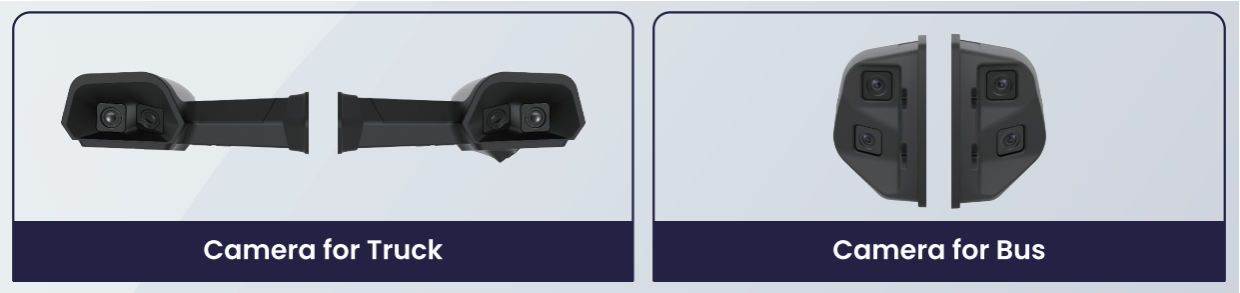
In terms of field of view, conventional mirrors are fixed in geometry and limited in angle. The AUTOEQUIPS CMS uses a dual-camera arrangement with wide-angle optical design, combining main view, wide view, close-side view and front close-range view configurations to cover the areas associated with Class II, IV, V and VI mirrors. The practical result is a reduction in blind zones along the rear flanks and immediately around the vehicle body.
Weather and night performance is the second clear differentiator. Glass mirrors collect rain and condensation and offer no defense against glare from following headlights. AUTOEQUIPS camera units integrate PTC / resistive-film automatic heating for defogging and de-icing, and pair anti-glare treatment with night-sensitive imaging to keep the displayed image usable when conditions deteriorate.
Aerodynamics and running costs complete the picture. Bulky mirror arms generate drag and noise; the compact exterior camera housings sit closer to the body, helping lower drag and energy use while reducing the likelihood of impact damage in tight lanes or at bus platforms.
In bus and truck applications, the displays are typically mounted near the interior A-pillars, close to the driver's natural sightline, so that checking the rear view requires a shorter glance. For operators, the combined effect is a safety improvement that also supports cost control.
Image Quality and Optical Technology: True High-Definition Vision Under Complex Lighting
A Camera Monitor System is only as good as the image it presents. Seeing clearly -- and seeing accurately -- is where optical coating and image processing work together.
AUTOEQUIPS lenses use high-end anti-reflection coating that reduces surface reflectance to below 1% while achieving optical transmittance above 90%. Lower surface reflection means fewer ghost images, and when combined with HDR, exposure control and downstream image processing, it improves visibility in direct sunlight and against strong light sources at night.
The imaging chain delivers 1920--1280 resolution at 60 fps with 120 dB high dynamic range, and includes LED Flicker Mitigation (LFM) to suppress the flicker and banding that pulsed LED headlamps and traffic signals otherwise produce on screen. An AI-ISP layer handles the harder cases: the extreme contrast at tunnel entrances and exits, and low-light scenes down to around 0.01 lux, with real-time exposure adjustment and noise reduction aimed at true-to-life color reproduction.
In practice, this is what prevents a truck driver from facing a blown-out white frame when exiting a tunnel, or a solid black patch when a following vehicle switches to high beams -- highlights are held back while shadow detail is lifted. The processed image is presented on displays rated around 1,000 cd/m² for sunlight readability, with stable, low-latency output consistent with R46 expectations.
Automotive-Grade Reliability and Dual-Camera Redundancy: Built for Extreme Environments and Heavy-Duty Operations
Commercial duty cycles are unforgiving, and hardware durability plus signal continuity matter as much as image quality. Any serious Camera Monitor System Manufacturer has to prove both.
The camera units carry IP69K protection, allowing high-pressure wash-down, and operate across a -40 °C to +85 °C range. High-hardness optical glass is used at the lens surface to resist sand and grit impact as well as abrasion from automatic car-wash brushes.
Signal integrity relies on automotive-grade FAKRA connectors and GMSL2 high-speed serial transmission, supporting long cable runs with low latency and strong electromagnetic immunity, validated against CISPR 25 Class 3 and ISO 16750 vibration testing at 5G levels.
Redundancy is designed in rather than added on. Each side module uses a dual-camera architecture, so if one optical channel behaves abnormally, the system can maintain core field-of-view output instead of exposing the driver to a blind spot through a single point of failure.
From long-haul trucking in sub-zero regions to hot, humid city bus operation, AUTOEQUIPS reports continuous stable operation exceeding 10,000 hours -- the kind of figure fleets care about, because it correlates with fewer vehicles off the road waiting for parts.
Intelligent Integration and Full-Service Support: Enabling Digital Upgrades for OEMs and Fleets
Replacing mirrors is the starting point, not the destination. The broader value lies in perception, system-level interaction, and lifecycle support.
The platform embeds an AI blind spot detection algorithm capable of identifying vehicles, pedestrians, and cyclists at distances up to approximately 35 meters in complex road environments. FOTA support covers remote firmware updates, log upload, and health monitoring, which helps fleets reduce maintenance overhead and diagnose issues without a workshop visit.
Equally important for OEMs is the engineering relationship. As a Camera Monitor System Manufacturer working directly with vehicle programs, AUTOEQUIPS supports pre-sales solution design, deep OEM customization and global after-sales response, and has built long-standing cooperation with a number of well-known commercial vehicle brands. During UN R46 and GSR type approval work, that support extends from HMI interaction design through to CAN bus protocol integration -- the details that usually consume schedule. Shortening that path helps partners bring compliant models to market sooner.
Conclusion
As regulations tighten and commercial vehicles grow more software-defined, CMS is moving steadily from a premium or niche option toward wider deployment across truck and bus platforms. AUTOEQUIPS continues to build on its technology base spanning AHD to LVDS architectures since 2019, automotive-grade quality discipline, UN R46-aligned compliance and 269 million kilometers of road validation.
To learn more about commercial vehicle CMS mirror replacement solutions and OEM customization services, please visit the AUTOEQUIPS official website: https://www.autoequips.com.

Media Contact
AUTOEQUIPS TECH CO., LTD.
+86 0755 8601 6485
Room 04/11F, Block C, Wanhai Building, No.1031 Nanhai Avenue, Nanshan District, Shenzhen, Guangdong, China
Source :AUTOEQUIPS TECH CO., LTD.
This article was originally published by IssueWire. Read the original article here.
More News

Crypto giant Binance attempting to recover $6.3bn stolen in hack linked to North Korea
The cyber-attack, which the company describes as complex, is believed to be the largest ever of its kind.

New York Bought an Electric Ferry. The City Can’t Charge It.
Locations across the country want to launch electric ferries to cut carbon emissions, but there are challenges to the rollout.

Binance Lost Over $6 Billion in Crypto Hack. Here’s What to Know.
Hackers made off with around $6 billion in digital currency in what could be the biggest crypto heist in history. Binance said it will cover the losses.

Yorkshire Water boss resigns after firm downgraded
Nicola Shaw, who has led the company since 2022, will step down in January, it is announced.

Binance Suspends Withdrawals After Crypto Hackers Steal $6.3 Billion
The crypto exchange said it was compromised in what could be the biggest crypto heist ever. One research lab attributed the theft to “North Korea’s elite hacking unit.”

A Powerful Mosquito-Hunting Laser Uses A.I. to Zap Winged Pests
Using sensors developed for self-driving cars, a Chinese start-up claims it can track and destroy tiny flying targets while avoiding people, pets and reflective surfaces.

Big Tech’s Data Center Blitz Is Burning Through Cash and Scaring Wall St.
Amazon became the latest tech company to announce swelling investments in A.I. amid stumbling share prices.

What we know about Binance's $6.3bn hack
Cyber correspondent Joe Tidy explains more about what is suspected to be the biggest hack in history.

Google value plunges by $500bn as its own AI search hits ad sales
Google spooked investors so badly that its stock hit a six-month low, after it revealed its AI own search summaries were affecting ad revenue.

Streeting denies 'kicking can down the road' in defence spending row
The government is under pressure to set out a path to greater defence spending, as ministers unveil plans to boost UK firms.

U.S. Oil Industry Earned Over $130 Billion in Profit During Iran War
That was almost three times as much as what businesses producing and refining oil in the United States made in the same period in 2025.

Crypto giant Binance hit by $6.3bn hack suspected to be largest in history
Two analytics firms have attributed the incident to a North Korean hacking unit called TraderTraitor.
YOUR NEWS, OUR NETWORK.
Do you have Great News you want to tell the world?
Be it updates about your business or your community, you can make sure that it’s heard by submitting your story to our network reaching hundreds of news sites across 6 verticals.