
New Research Consortium Report Explains Why PAYERS Must Take the Lead in Changing the Way We Approach and Treat Cancer
Sep 16, 2026
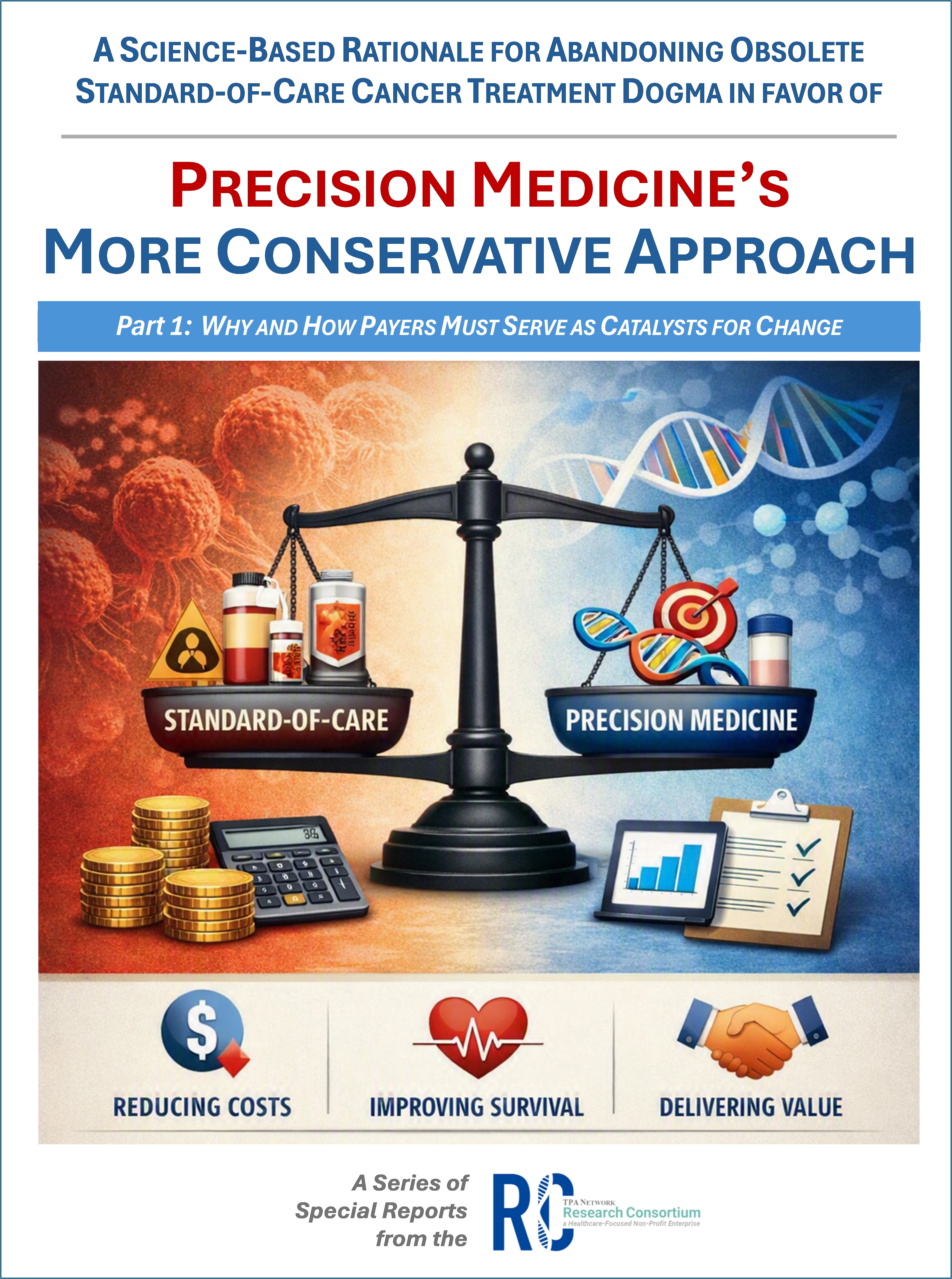
The transition from outdated, one-size-fits-all standard-of-care cancer treatment to science-based personalized care cannot be left to physicians / health systems: it must be led by payers / employer plan sponsors who make critical coverage decisions
San Diego, California Sep 15, 2026 (Issuewire.com) - A new report from the nonprofit TPA Network Research Consortium explains why health insurers must bear much of the responsibility for changing how cancer is approached and treated. The first-in-a-series report details how payers can help drive this change by following the organization's Precision Medicine Protocol, a framework for supporting a more individualized approach to cancer care.
It is possible that as many as 80% of cancer patients in the United States receive suboptimal care, in large part because of the continued reliance on organ-based, one-size-fits-all clinical guidelines that do not adequately account for the variation among individual cancers. When treatment decisions are guided by these generalized approaches rather than by the unique characteristics of each patient's cancer, patients may receive toxic, high-cost regimens that offer limited or no clinical value. Instead, treatment should be more appropriately aligned with the biology of the disease it is intended to treat.
Precision medicine integrates modern genomics into cancer care, substantially deepening our understanding of the disease and transforming how it can be treated. Rather than relying on sameness-based, standard-of-care approaches, it uses each patient's unique molecular profile to guide the selection of therapies that are biologically matched to their cancer. This approach helps identify targeted and potentially effective drugs while eliminating treatments that are unlikely to provide clinical value. By avoiding ineffective therapies, precision medicine can reduce unnecessary toxicity and improve outcomes while containing cost. It is a conservative, more cautious and science-based approach to care -- one that stands in clear contrast to blindly following obsolete, pre-genomic-era treatment dogma.
Research Consortium founder Richard Nicholas, a 48-year healthcare industry veteran, believes that payers continue to perpetuate suboptimal cancer care because they have not made a meaningful commitment to precision medicine. In his view, that commitment is essential to ensuring that cancer treatment decisions better reflect the unique characteristics of each patient's cancer.
"Organ-based cancer treatment must be superseded, as it excuses decision-making based on incomplete knowledge. By contrast, precision medicine's science-based, look-before-you-leap treatment approach is actually a more conservative course of action versus blindly following obsolete pre-genomic era dogma.
"It is high time for payers and health plan sponsors to earnestly embrace precision medicine. To do otherwise would be to continue to deny patients access to vital genomic testing and the option to try potentially viable FDA-approved cancer drugs; essentially permitting continued wasteful spending on high-cost, low-clinical-value drugs" Richard L. Nicholas
Payers' Responsibility to Advance Precision Medicine
Comprehensive health care coverage is a cornerstone of effective cancer care; and coverage decisions shape access, quality, cost, and outcomes throughout the cancer journey, influencing everything from the initiation of treatment through long-term survivorship. When coverage decisions deny, delay, or disrupt access to care, they affect not only the treatment patients receive but also the outcomes they experience. Nicholas believes that because payers make coverage decisions, much of the responsibility for driving the transition to precision medicine rests with them. He reasons that responsibility cannot rest entirely with providers and health systems, which do not control coverage determinations. Payers must therefore earnestly embrace precision medicine and support coverage decisions that advance more effective cancer care, rather than continuing to accept ineffective treatments and wasteful spending on them.
A Practical Framework for Advancing Precision Medicine
To help health insurers and self-funded employers drive meaningful change, the nonprofit Research Consortium created a Precision Medicine Protocol as a practical framework for supporting more effective, individualized cancer care. This report, the first in a series on precision medicine, describes the protocol and explains how and why payers can support its use. It also examines how payers can promote cancer care that is better aligned with individual patient needs while addressing the quality, cost, and value considerations that shape coverage decisions. Later installments in the series will provide additional detail about the protocol, challenge conventional thinking about the cost and value of combination drug treatments and show payers how to gain greater control over oncology specialty-drug spending.
The report is available for download here.
Should you wish to learn more about how you can support our work, please click on this link to our new fundraising campaign, Advancing Personalized Cancer Care. Cancer patients everywhere will be glad you did.
About the TPA Network Research Consortium
The TPA Network Research Consortium is a non-profit, industry-wide healthcare research initiative that helps providers evaluate and assess new medical technologies and innovations, plan participants obtain leading-edge healthcare, scientists advance medical research, and payers reduce risk ... by conducting payer-focused translational research, in real-world settings. Visit ResearchConsortium.org
Media Contact
TPA Network Research Consortium, Ltd.
8583954114
555 Saturn Blvd, Suite B408
Source :TPA NETWORK RESEARCH CONSORTIUM LIMITED
This article was originally published by IssueWire. Read the original article here.
More News

Novo Nordisk Warns of First Sales Drop Since Start of Ozempic
The once high-flying Danish drugmaker has struggled to fend off rivals in the weight-loss industry, especially Eli Lilly, which gave a much rosier outlook to investors.

Why A.I. Fears Are Battering Stocks, Again
New tools by artificial intelligence companies like Anthropic have reignited worries that businesses will pare down their subscriptions to software services.

The Questionable Science Behind the Odd-Looking Football Helmets
The N.F.L. claims Guardian Caps reduce the risk of concussions. The company that makes them says, “It has nothing to do with concussions.”

Restaurant boss 'devastated' at having to close
Bar owner Jobe Ferguson says he is devastated to close TNQ in the Northern Quarter after 22 years.

New York Times Added 1.4 Million Digital Subscribers in 2025
The company reported total revenue of $802.3 million for the fourth quarter of 2025, up 10.4 percent from a year earlier.

Are You ‘Biohacking’ to Perform Better at Work? We Want to Hear From You.
Please tell us what changes you’ve made to your health and wellness practices to improve your brain function and job performance. We may include your experiences in an article.

Wegovy maker warns price cuts 'painful' for firm as shares plunge
Novo Nordisk is facing "unprecedented" price pressures, "intensifying competition" and patents expiring.

Bedrock, an A.I. Start-Up for Construction, Raises $270 Million
The two-year-old company, founded by veterans of the autonomous vehicle business Waymo, is seeking to automate excavators and other building equipment.

Gold rebounds above $5,000 after US downs Iran drone
Precious metal price voliatility continues as geopolitical tensions push investors to safe-haven assets.

The yachting industry searches for alternatives to teak
Prized for its beauty, teak is in short supply, forcing the yacht industry to look for alternatives.

How will car loan compensation payments work?
Millions could be entitled to compensation as a result of commission arrangements between lenders and dealers.

Bulgarians Adopt the Euro With a Whisper of Melancholy but Few Tears
In a country roiled by political upheaval recently, retiring the longtime currency, the lev, prompted some concern about inflation but little other angst.

Trump Says Housing Prices Should Be Higher, Not Lower
When President Trump said he wanted to drive housing prices up, not down, he was speaking to a conundrum that has flummoxed policymakers for decades.

Congress Reins In Drug Middlemen in Effort to Lower Prescription Prices
The legislation will impose new restrictions on pharmacy benefit managers, giant companies like CVS Caremark, Optum Rx and Express Scripts that oversee prescription drug benefits.
What's going on with the price of gold?
Gold has fallen from recent highs but there are several reasons investors are still finding refuge in the precious metal.

Pinterest sacks engineers for tracking staff job cuts
The social media platform recently announced that it was axing around 15% of its workforce.

‘Neoroyalism’ and What It Says About Trump
Experts are reaching to divine the president’s approach to global policy and economics, with one theory seeing antecedents in centuries-old dynastic rule.

Meat Processors Take a Hit as Cattle Prices Remain High
Tyson Foods said its beef business could lose up to $500 million this year as the supply of cattle reaches a 75-year low.

Grammy Awards Audience Declines by a Million Viewers
The show on Sunday drew about 14.4 million people. It is the second consecutive year that the awards ceremony attracted a smaller audience.

X offices raided in France as UK opens fresh investigation into Grok
Elon Musk's X and Grok platforms are facing increased scrutiny from authorities on both sides of the channel.

Stephen Miran Resigns From White House as Fed Term Stretches On
Mr. Miran had taken a leave of absence from advising the president after adding a role at the Federal Reserve, drawing criticism from Democrats.

Netflix Leader Pushes Warner Deal Before Skeptical Lawmakers
Senators asked Ted Sarandos about whether the acquisition would raise prices, squeeze talent and degrade the moviegoing experience.

Netflix and Warner Bros struggle to defend merger
Concerns were raised by a subcommittee including potential price rises and the future of cinemas.

The Chinese planemaker taking on Boeing and Airbus
Comac's passenger jet is attracting customers in South East Asia where demand for affordable aircraft is growing.

Walmart Joins Tech Giants With $1 Trillion Market Valuation
The company’s rapid e-commerce growth and push into automation and artificial intelligence propelled its stock into the trillion-dollar club.

Snow Drought, Political Shifts and Strikes Batter Ski Industry in Western U.S.
Little snowpack, strikes by mountain staff and Trump administration policies that are keeping international visitors away have made this a difficult season in the Rockies and beyond.

Police Search X’s Premises in France as Prosecutors Summon Elon Musk
The move followed a yearlong investigation into X and escalated a wider standoff between European officials and American tech companies over the regulation of social media.

‘Don Colossus,’ a Golden Statue of President Trump, Waits for Its Home
A group of cryptocurrency investors backing a memecoin hopes the statue will soon be installed at one of Mr. Trump’s golf courses in Florida.

Trump and India Call Off Their Trade War, but the Terms of Peace Are Murky
Officials and business leaders welcomed lower tariffs, but India has not yet confirmed that it would stop buying Russian oil, which President Trump said Prime Minister Narendra Modi had agreed to.

Brad Karp Says He Regrets Interactions with Epstein
Newly released emails between Mr. Karp, the chairman of Paul Weiss, and Jeffrey Epstein reveal a number of social interactions between them.

Disney names Josh D'Amaro as new chief executive
The media giant chooses the head of its amusement park business to replace longtime boss Bob Iger.

Jeffrey Epstein’s Trust Reveals Beneficiaries of His Fortune
Jeffrey Epstein wanted most of his money to go to his girlfriend. Mr. Epstein’s brother and a Harvard math professor were also named beneficiaries.

After Years of Increases, PepsiCo Pledges to Cut Prices on Snacks
The food and beverage giant said consumers were facing “affordability limitations.”

Investigation Finds Credit Suisse Had Wider Nazi Ties Than Previously Known
But a lawyer who has been scrutinizing archives and UBS are in a dispute over access to about 150 documents.

Walmart becomes first retailer to hit $1tn market value
The milestone reflects the US retail giant's booming e-commerce business and investors' embrace of its AI investments.

The New Key to Restaurant Success? A Simple but Clever Model.
Novel approaches to the all-day cafe are working for diners and creative chefs across the country.

PepsiCo to cut some US snack prices after backlash
The snack conglomerate is cutting the price of products including Doritos, Cheetos and Lays

Disney Names Josh D’Amaro as Next C.E.O.
Mr. D’Amaro, 54, has most recently served as chairman of Disney Experiences, a division that includes theme parks, cruise vacations and consumer products.

Christy Tanner Named C.E.O. of New York Public Radio
Ms. Tanner was previously an executive at CBS News and serves on the board of Audacy, a major U.S. broadcaster and podcast producer.

Stop watching Netflix and go to the pub, Welsh first minister says
Eluned Morgan said her government can't be expected "to step in and do the work" to save struggling pubs.
YOUR NEWS, OUR NETWORK.
Do you have Great News you want to tell the world?
Be it updates about your business or your community, you can make sure that it’s heard by submitting your story to our network reaching hundreds of news sites across 6 verticals.