
Selection Guide for Automotive Safety Glass Testing: Focus on Ghost Image Angle Measurement Solutions
Sep 20, 2026
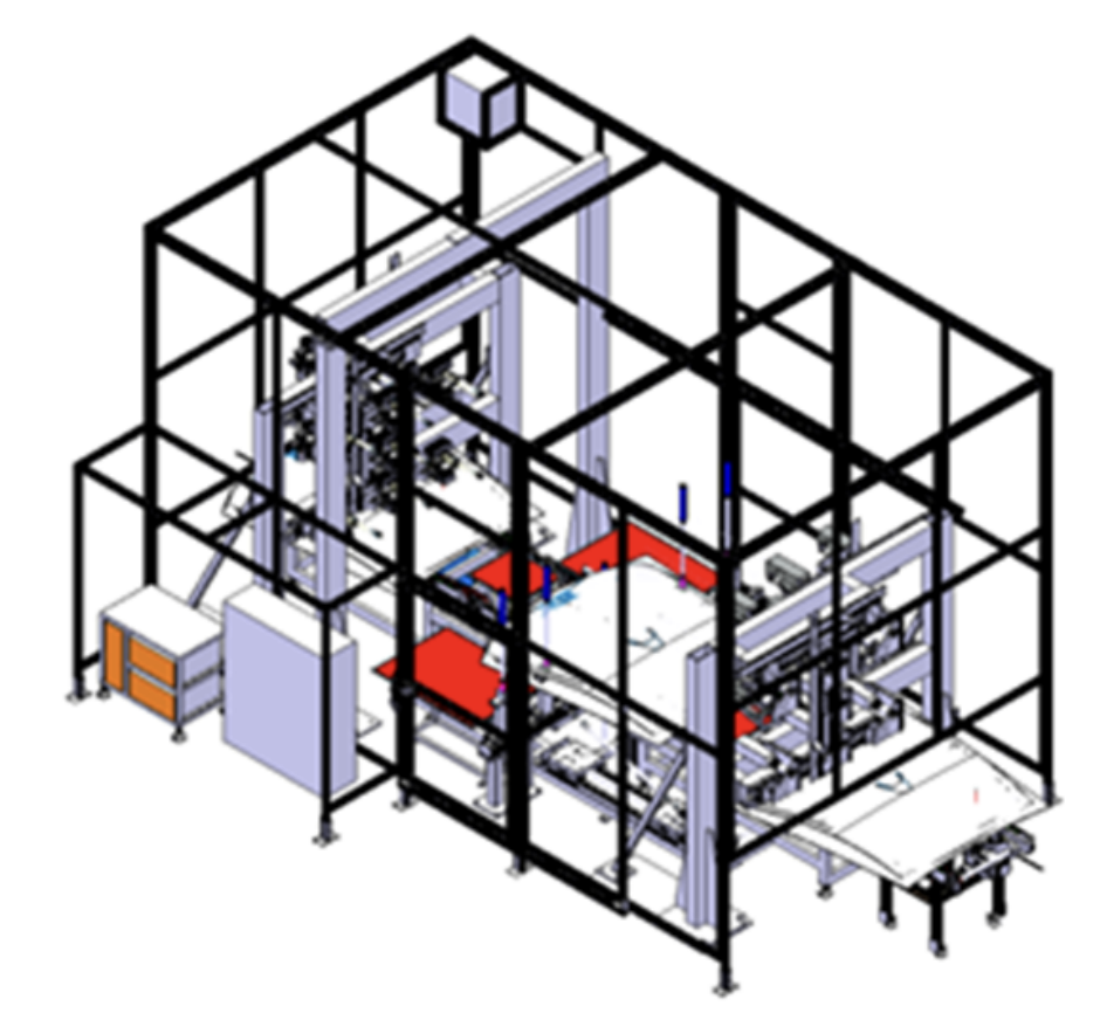
Beijing, China Sep 20, 2026 (Issuewire.com) - Jeffoptics's Solutions
Vehicle safety and visual comfort rely heavily on the optical quality of laminated windshields and side windows. Modern automotive designs feature steeply raked windshields and head-up display (HUD) systems, making optical distortions increasingly noticeable to drivers. Among these visual defects, secondary images--commonly known as ghost images--pose significant challenges to driving safety. Addressing this requires precision engineering and rigorous quality control.
This selection guide explores how procurement teams and quality engineers can identify high-performance testing systems, focusing on advanced Ghost Image Angle Measurement Solutions designed to evaluate secondary image separation in automotive safety glazing.
Understanding Ghost Image Formation and Core Measurement Principles
Ghost images occur when light refracts through the outer and inner glass surfaces of a laminated windshield, creating a primary image and a displaced secondary image. For vehicles equipped with HUD technology, even minor angular deviations can cause double vision or ghosting, leading to driver fatigue and compromised reaction times.
Evaluating this phenomenon requires specialized optical wedge angle deviation testing equipment and secondary image separation test systems. The measurement process quantifies the deviation angle between the two refracting surfaces and determines the separation distance under simulated real-world viewing conditions. Testing systems must capture precise angular metrics to ensure compliance with stringent international regulations.
Step 1: Prioritize Critical Parameters, Materials, and Performance Metrics
When evaluating testing equipment, procurement professionals must focus on parameters that directly influence measurement accuracy and production stability.
- Angular Resolution and Repeatability:High-precision systems must resolve angular variations down to arcseconds to detect micro-deviations in complex curved glass. Consistent output across multiple testing cycles ensures reliability in high-volume production lines.
- Material and Process Compatibility: Automotive glass manufacturing involves diverse materials, ranging from standard polyvinyl butyral (PVB) laminated assemblies to acoustic and solar-control interlayers. Testing equipment must maintain optical accuracy regardless of coating types, dark tint levels, or complex curvatures.
- Testing Environment Conditions: Equipment must perform reliably under factory floor conditions, resisting ambient light interference and mechanical vibration during continuous operation.
Step 2: Verify Compliance Standards and Regulatory Alignment
Testing instruments must adhere to recognized global benchmarks to ensure acceptance across international markets and supply chains.
- Mandatory Standards: Equipment should fully comply with established industrial safety and optical standards, including GB, ECE R43, ASTM, and EN.
- Quality Management Systems: Ensure that the hardware provider operates under certified quality protocols, such as ISO 9001, to guarantee manufacturing consistency and reliable calibration tracking.
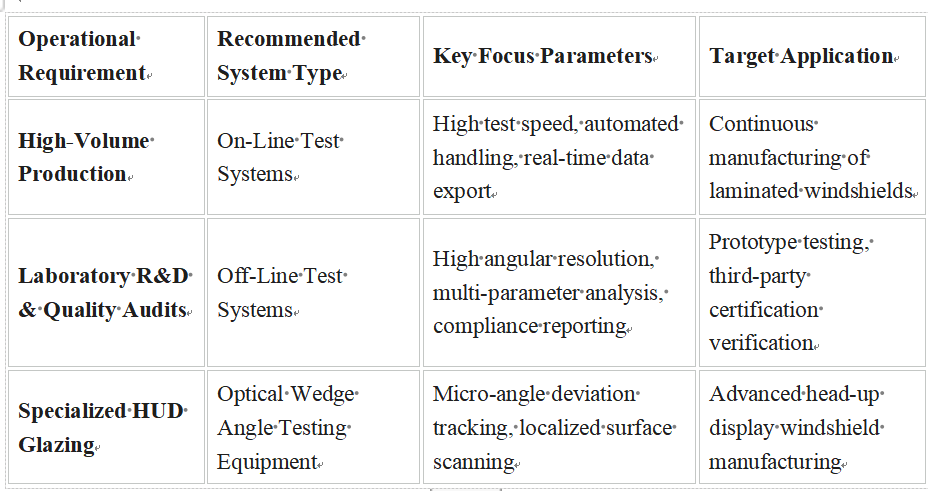
Step 3: Match Testing Solutions to Operational Demands
Selecting the correct testing infrastructure depends on manufacturing scale, workflow integration, and specific compliance targets.
Step 4: Identify Common Causes of Procurement Failure
Understanding why testing equipment deployments fail helps buyers avoid costly operational bottlenecks and inaccurate quality gates.
- Ignoring Environmental Interference: Selecting laboratory-grade optical equipment for harsh factory floors without proper vibration isolation or ambient light shielding leads to data drift and false rejections.
- Mismatched Sample Geometry Support: Purchasing systems with rigid fixture designs that cannot accommodate new vehicle windshield curvatures or larger laminated panels restricts future production flexibility.
- Inadequate Software Integration: Choosing instruments with closed-loop software that cannot export real-time data into factory execution systems (MES) creates isolated data silos and slows down quality traceability.
- Overlooking Calibration and Maintenance Support: Failing to verify local calibration services or technical support response times results in prolonged downtime when optical sensors require realignment.
Step 5: Verify Supplier Competence and Technical Credibility
Procuring high-precision inspection hardware requires rigorous vetting of manufacturer credentials beyond basic marketing claims.
- Review Intellectual Property and R&D Depth: Examine the supplier's authorized patent portfolio and software copyrights. For instance, advanced implementations such as the SIS series on-line and off-line secondary image separation test systems demonstrate how integrated optical design addresses complex automotive testing requirements. Similarly, specialized configurations like the optical wedge angle deviation testing equipment illustrate the importance of purpose-built hardware for high-accuracy manufacturing environments.
- Evaluate Proven Field Deployments: Request case studies or reference sites where similar testing architectures operate successfully in high-throughput automotive glass facilities.
- Assess Engineering Support: Confirm that the vendor provides comprehensive installation, operator training, routine calibration, and full-cycle technical support. Industry leaders such as Jeffoptics combine decades of specialized R&D with strict adherence to ISO 9001 quality management systems, ensuring that inspection instruments meet the rigorous demands of global automotive supply chains.
Securing Precision Quality Control Solutions for Your Production Line
Integrating reliable optical inspection systems safeguards product quality and ensures strict adherence to international safety regulations. Facilities seeking to upgrade their testing capabilities can align their technical requirements with proven measurement architectures.
To evaluate specific testing parameters, custom integration requirements, or system configurations for automotive safety glass production, explore the comprehensive offerings at https://www.jeffoptech.com/
Source :Beijing Jeffoptics Company Limited
This article was originally published by IssueWire. Read the original article here.
More News

Rivian C.E.O. RJ Scaringe Has Some Ideas for How to Make More Cars in America
RJ Scaringe thinks it will take robots, tariffs and diplomacy to maintain a manufacturing base in the United States.

Mistakes? We’ve Made a Few
For most of its life, The New York Times has tried to correct its errors. These efforts have not always been perfect.

As the Rich Buy Bigger Boats, Private Equity Is Investing in the Booming Marina Business
The private equity firm Blackstone now owns more marinas than anyone in the world.

Families missing out on NHS money for healthy food
Figures show as few as 64% of eligible families are claiming NHS money to buy milk, fruit and veg.

CNN, MS NOW and Politico Barred From White House After Trump’s Ban
The prohibition on certain journalists was a major escalation in President Trump’s war on the media, and will probably face a legal challenge.

Trump says he plans to form AI Force, appoint AI 'Czar'
US President Donald Trump said Saturday that he is forming an "AI Force" and will announce an "AI Czar" in the near future.

Not all AI workers think the tech could kill everyone
In text exchanges and conversations, multiple people who have worked for leading companies are sceptical of the warnings.

California Cracks Down on Influencers’ Undisclosed Political Ads
Under a new law, creators could face fines of $5,000 per post if they don’t disclose that they were paid to make political content.

Converse Removes Ad That Drew Comparisons to K.K.K. Imagery
“This should not have happened and we will do better,” said Converse, which apologized for the ad. Critics said it depicted a Ku Klux Klan robe and a lynching.

India Is Again Squeezed Between the Threat of Trump Tariffs and Russian Oil
India is trying to secure affordable energy while preserving a crucial relationship with Washington, a balancing act made harder by turmoil in global energy markets.

Amodei, Anthropic’s Leader, Exposed A.I.’s Dangers. It’s Time to Act.
The Times columnist Kevin Roose sees reasons for optimism — and worry — as the world wakes up to what Silicon Valley has been talking about for years.

At DraftKings, AI Targets the Gamblers Likeliest to Lose
Data science helps determine who receives betting incentives, but the company has resisted using similar technology to protect gamblers at risk of addiction.
YOUR NEWS, OUR NETWORK.
Do you have Great News you want to tell the world?
Be it updates about your business or your community, you can make sure that it’s heard by submitting your story to our network reaching hundreds of news sites across 6 verticals.