
Amid turmoil, Afghanistan pavilion arrives at Dubai's Expo
Oct 7, 2021
Afghanistan's pavilion has finally arrived at the first world's fair in the Middle East a week after Dubai's Expo opened without it
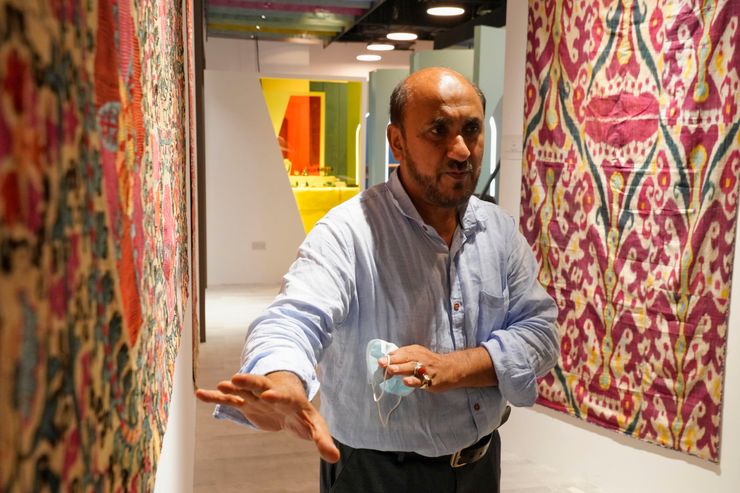
DUBAI, United Arab Emirates (AP) — When Afghanistan's president was killed in a Communist coup in 1978 and the country plunged into violent chaos, Mohammed Omer Rahimy bundled up his family’s treasures and fled to Vienna.
More than 40 years later, amid yet another violent upheaval in his home country, Rahimy found himself frantically loading those same artifacts onto a plane in cotton-stuffed boxes — this time to the first world's fair in the Middle East.
For the 62-year-old Rahimy, it was a mad rush to Dubai’s Expo. He barely slept. But Rahimy was careful. He chose among the finest bronzes, jades, calligraphy and pottery from the vast Afghan antique collection he had amassed in Austria over the decades, which arrived at the fair earlier this week..
“It is important for the world to know that even though there is war and we are poor, our history is rich," Rahimy said. "Our culture is rich.”
The stakes were high, he felt. The historic fair had opened, but Afghanistan was nowhere to be found on the fairgrounds, weeks after the Taliban took over the country with lightning speed. The image of the shuttered Afghan national pavilion - for days a haphazardly furnished office space — at Dubai's Expo splashed across the internet, a grim reminder of the disarray that has marked the Taliban’s return to power.
“It hurt me so much to see the exhibit closed," said Rahimy. “I begged the Expo ... please, let me do something good for my people."
Afghanistan's previous government had organized the exhibit months before Kabul fell and the deposed President Ashraf Ghani fled to Abu Dhabi, the capital of the United Arab Emirates.
With flights still largely halted in and out of Afghanistan and the country careening into an economic abyss, Rahimy said the pavilion would have remained hauntingly empty had he not stepped in.
An independent antiques dealer who has helped supply Afghanistan's Expo showcases for years, Rahimy says he paid out of pocket this time to ship his family heirlooms and other artistic artifacts from Vienna to Dubai. The collection includes rusted oil lamps incised with Islamic calligraphy from the 16th century, dazzling lapis lazuli necklaces mined from the country's north and massive hand-woven carpets that he said still carry the scent of his mother.
“People in Afghanistan have no water, they have no bread. Now is the time I felt we really needed this kind of exhibit," Rahimy said, describing the economic crisis that has left ordinary Afghans struggling to survive and threatened to unravel whatever remains of America's nation-building ambitions.
Rahimy can opine for hours on Quranic book stands made from jade and the history of Afghanistan's perfume trade. But he grows quiet when asked about his countless relatives who remain in Kabul under its new Taliban rulers. Only his niece managed to escape, flying to Philadelphia during the final days of the U.S.-led evacuation.
“They are like everyone else,” he said of relatives who remain in Afghanistan, his voice trailing off.
Rahimy insists the overarching purpose of Afghanistan's pavilion is to put aside the turmoil dogging the country. But like elsewhere at Dubai's Expo, recent politics still manage to pervade it. Pavilions staffers stamp visitors' mock passports with the national emblem of the Afghan government installed after the 2001 U.S.-led invasion, not the Quranic version used by the Taliban during their earlier rule.
The rabab, a traditional Afghan folk instrument, hangs from one wall. Its players, Rahimy said, are too terrified to perform, now confronting an uncertain future amid signs that the Taliban will move to ban nonreligious music.
The wider context also isn't lost on the pavilion's visitors, after scenes of anguish and unrest transfixed much of the world as America's longest war came to a bitter end.
“The scenes of people at the airport in Kabul speak louder than anything,” said 36-year-old Chamali Smith from St. Helens, United Kingdom. But scanning the shelves stacked with Afghan saffron and stone, she added: “They've done remarkably well though here, I'm really happy and proud for them.”
Rahimy is just proud to say that Afghanistan is finally open at Expo. He hopes that the temporary six-month exhibit can provide a more lasting picture of what his nation is and has been.
“Regimes come and go. People get old and die. But the land stays. The mountains stay,” he said. “People wear amulets for good luck and they play instruments and they wash their hands in bowls.”
More News

M.L.B. Playoff Ads With Sydney Sweeney and Megan Fox Draw Backlash
Commercials with Sydney Sweeney promoting a gambling platform and Megan Fox endorsing male enhancement have rankled fans, and even athletes. Who is in charge?

Netflix Hurries to Rewrite Its Narrative With Layoffs and a Sudden Firing
Despite strong revenues and profits, the streaming service cut 1,000 jobs and jettisoned its chief content officer. Drops in the stock price and viewer engagement are to blame.

Why Bad News in the Bond Market May Be Good News for Investors
In the contrarian logic of investing, rising interest rates have made bonds much more attractive, our columnist says.

U.S. Budget Deficit Nears $2 Trillion, a Reality Check for Trump’s Cost Cutting
Higher interest rates are inflating borrowing costs as the Trump administration spends on the Iran war and tariff refunds.

Indonesian Stocks Plunge as MSCI Threatens to Drop Market from Indexes
The potential downgrade by MSCI, an influential index provider, adds to a deepening crisis of investor confidence in the economic policies of President Prabowo Subianto.

Warsh Vows to Tame Inflation as A.I. Delivers ‘Shock’ to Economy
The Federal Reserve chairman stuck to his pledge to avoid providing guidance about the path forward for interest rates, but did nothing to convey an urgency to raise them later this month.
A new railway corridor: How Nanning links Chinese and ASEAN markets
A new railway corridor: How Nanning links Chinese and ASEAN markets

Watch: Did Tesla really just unveil a flying car?
Tesla CEO Elon Musk showcased the vehicle at a facility owned by his SpaceX company, which helped develop the model.

China and Europe are building new connections in aerospace
China and Europe are building new connections in aerospace – from skies to stars. On the one hand, their deep industrial partnership is scaling global civil aviation to new heights. On the other hand, scientific collaboration is opening new possibilities for space exploration and deepening our understanding of the Sun-Earth system.

BizTalk | Exclusive interview with Former PM of Bosnia and Herzegovina
In this episode of BizTalk, CGTN's Guan Xin speaks with Zlatko Lagumdzija, former prime minister of Bosnia and Herzegovina, about China's development and its role in global governance.

When Will the Fed Move on Rates?
Kevin Warsh, the central bank’s chairman, suggested he wouldn’t push to raise borrowing rates this month. But persistent inflation may force the Fed’s hand.

Banks expect to be hit with higher taxes in Budget
Senior banking executives have told the BBC they expect to be "on the menu" in the chancellor's Budget tax later this month.