
Asian shares mostly decline on global technology downturn
Aug 9, 2022
Asian shares are mostly declining amid a global fall in technology shares, including Japan’s SoftBank, which just reported hefty losses caused by the market downturn
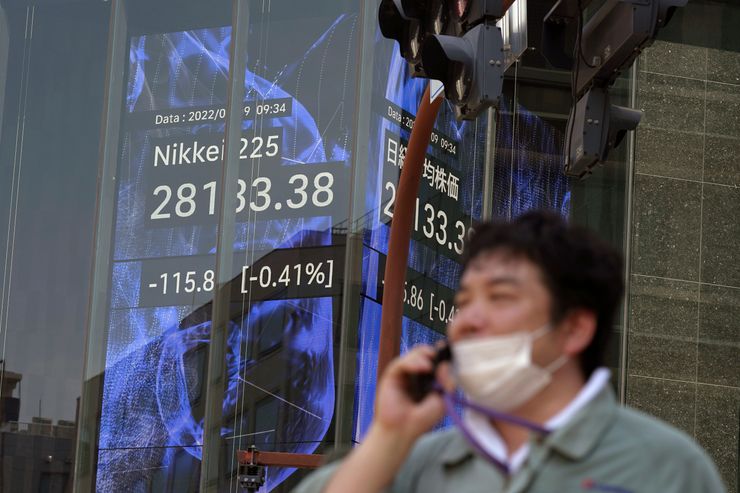
TOKYO (AP) — Asian shares mostly declined Tuesday amid a global fall in technology shares, including Japan's SoftBank, which has reported hefty losses caused by the market downturn.
Such worries are coming on top of concerns about inflation and what central banks might do to curb that trend. Higher interest rates tend to work as a minus for share prices.
Shares fell in Tokyo but rose in other regional markets. U.S. futures edged higher while oil prices fell.
Japan's technology investor SoftBank Group Corp. dropped more than 4% in Tokyo trading. On Monday it reported a record quarterly loss of $23 billion. A global nose-dive of technology-related issues, such as Chinese e-commerce giant Alibaba, dragged on its sprawling portfolio of investments.
Analysts monitoring Asian markets said regional tensions also remain a risk, because of the flareup between China and Taiwan after the recent visit of U.S. House Speak Nancy Pelosi to Taiwan.
China has said it's extending threatening military exercises surrounding Taiwan, disrupting shipping and air traffic and raising up a notch worries about trade.
“It is worth keeping track of the geopolitical landscape as any major developments on the China/Taiwan front could impact overall risk demand. China confirmed it would extend military drills around Taiwan, and the military will conduct ‘regular’ exercises on the eastern side of the median line of the Taiwan Strait,” said Anderson Alves at ActivTrades.
Japan's benchmark Nikkei 225 dipped 0.8% in morning trading to 28,024.96. Australia's S&P/ASX 200 edged up 0.1% to 7,028.40. South Korea's Kospi edged 0.1% higher to 2,495.87. Hong Kong's Hang Seng jumped 0.8% to 20,207.74, while the Shanghai Composite edged up 0.3% to 3,246.95.
Also of concern are the rising cases of COVID-19 in some Asian nations, and their potential impact on supply chains that are a lifeline to some of the region's biggest manufacturers.
Technology stocks were the biggest drag on Wall Street Monday. The S&P 500 slipped 0.1% to 4,140.06 and the Nasdaq shed 0.1% to 12,644.46. The Dow Jones Industrial Average closed 0.1% higher, at 32,832.54. The Russell 2000 rose 1% to 1,941.21.
The market’s latest gyrations came as investors prepare for a busy week of economic updates that could help answer whether the Federal Reserve’s efforts to cool the economy and quell inflation are working, or whether the central bank will continue aggressively raising interest rates. Wall Street is worried that the Fed could hit the brakes too hard and cause a recession.
The Fed is expected to hike short-term interest rates by another 0.75 percentage points at its next meeting.
“Early indications of inflationary pressures appear to be easing, which will be an important catalyst for the market,” said Quincy Krosby, chief global strategist for LPL Financial.
The benchmark S&P 500 index is coming off three consecutive weekly gains.
The U.S. Labor Department will release its July report for consumer prices on Wednesday, followed by its report for prices at the wholesale level on Thursday.
This week’s inflation updates follow reports last week showing the employment market remains strong. While that’s good for the economy, it has complicated the Fed's effort to cool inflation.
Investors are still reviewing the latest round of corporate earnings, which could also provide more details on how hard inflation is hitting consumers and businesses.
Clean energy companies gained ground following the Senate's approval for Democrats’ big election-year economic package, which includes funding to help fight climate change. First Solar rose 4.7%.
Bond yields fell. The yield on the 10-year Treasury, which influences interest rates on mortgages and other consumer loans, slipped to 2.76% from 2.83% late Friday.
In energy trading, benchmark U.S. crude fell 23 cents to $90.53 a barrel in electronic trading on the New York Mercantile Exchange. It added $1.89 to $90.76 a barrel on Monday.
Brent crude, the international standard lost 22 cents to $96.43 a barrel.
In currency trading, the U.S. dollar fell to 134.78 Japanese yen from 134.98 yen. The euro cost $1.0191, inching down from $1.0193.
___
AP Business Writers Damian J. Troise and Alex Veiga contributed.
___
Yuri Kageyama is on Twitter https://twitter.com/yurikageyama
More News

Why Bad News in the Bond Market May Be Good News for Investors
In the contrarian logic of investing, rising interest rates have made bonds much more attractive, our columnist says.

U.S. Budget Deficit Nears $2 Trillion, a Reality Check for Trump’s Cost Cutting
Higher interest rates are inflating borrowing costs as the Trump administration spends on the Iran war and tariff refunds.

Indonesian Stocks Plunge as MSCI Threatens to Drop Market from Indexes
The potential downgrade by MSCI, an influential index provider, adds to a deepening crisis of investor confidence in the economic policies of President Prabowo Subianto.

Warsh Vows to Tame Inflation as A.I. Delivers ‘Shock’ to Economy
The Federal Reserve chairman stuck to his pledge to avoid providing guidance about the path forward for interest rates, but did nothing to convey an urgency to raise them later this month.

Watch: Did Tesla really just unveil a flying car?
Tesla CEO Elon Musk showcased the vehicle at a facility owned by his SpaceX company, which helped develop the model.

When Will the Fed Move on Rates?
Kevin Warsh, the central bank’s chairman, suggested he wouldn’t push to raise borrowing rates this month. But persistent inflation may force the Fed’s hand.

Banks expect to be hit with higher taxes in Budget
Senior banking executives have told the BBC they expect to be "on the menu" in the chancellor's Budget tax later this month.

Feel Like You’re Overpaying for Hotels? Blame Expedia, a New Lawsuit Says.
The booking giant is accused of breaking federal antitrust laws and forcing millions of customers to overspend on stays by as much as 30 percent.

Tesla Debuts 2026 Roadster ‘Flying’ Electric Sports Car
Elon Musk’s company and other automakers, like Jaguar and Bentley, are trying to sell very expensive electric cars to people who usually prefer gasoline-fueled luxury and performance.

Trump Hasn’t Lowered Drug Prices for These Voters
President Trump has been promoting his efforts to reduce drug prices, but many Americans have not seen relief from rising costs for prescriptions and insurance premiums.

Fuel costs squeezing margins for some businesses
Diesel recently topped £2 per litre and there is concern that a duty freeze will not go far enough.

'TV and cheap booze' blamed for landlord quitting
Lincolnshire has lost 27% of its pubs and bars since 2009 and some are calling on the government to act against cheap supermarket booze.