
Asian shares rise as receding debt fears spur Wall St rally
Oct 7, 2021
Asian shares are higher, tracking a rally on Wall Street after signs of progress on resolving the standoff in Congress over the debt ceiling
TOKYO (AP) — Asian shares rose Thursday, tracking a rally on Wall Street after signs of progress on resolving the standoff in Congress over the debt ceiling.
Japan's benchmark Nikkei 225 gained 0.5% to finish at 27,678.21. Australia's S&P/ASX 200 added 0.7% to 7,256.70. South Korea's Kospi jumped 1.8% to 2,959.46. Hong Kong's Hang Seng surged 2.9% to 24,659.84. Trading was closed in Shanghai for a Chinese national holiday.
Stephen Schwartz, a senior director at Fitch, said he believes the regional economy will start to recover with the growing vaccination efforts in Asia, which mean restrictions to curb the spread of the coronavirus will get lifted.
But southern and southeastern Asia, where vaccination rollouts have lagged, remain vulnerable to COVID-19 “pandemic-related setbacks." Recent problems in China's property sector are another risk, he added.
“Slower growth in China, together with the tapering we expect by the U.S. Fed, could have broader negative repercussions, especially for the region’s emerging and frontier markets,” he said.
Japan's economic prospects also remain murky as new Prime Minister Fumio Kishida gives his first policy speech later this week. Although he has promised to boost incomes, he has not outlined specifics and is not widely perceived as a proponent of the regulatory and structural changes analysts have long said Japan sorely needs. Some skeptics worry that any new spending will merely push the country into deeper debt.
Kishida has also spooked investors by voicing support for a capital gains tax.
In the U.S., investors are hoping Congress may manage to temporarily extend the federal government's debt ceiling and buy lawmakers time to reach a more permanent resolution. The market recovered from a morning loss shortly after Senate Republican leader Mitch McConnell offered Democrats an emergency short-term extension to the federal debt ceiling into December.
The S&P 500 rose 0.4%, to 4,363.55. The Dow Jones Industrial Average rose 0.3% to 34,416.99. The Nasdaq gained 0.5%, to 14,501.91. The tech-heavy index had been down 1.2% before the afternoon rally.
Small-company stocks, a gauge of confidence in economic growth, fell: The Russell 2000 index gave up 0.6% to 2,215.
If the nation's debt ceiling, which caps the amount of money the federal government can borrow, isn’t raised by Oct. 18, the country “would likely face a financial crisis and economic recession,” Treasury Secretary Janet Yellen told Congress last week.
During a meeting Wednesday with bank executives, President Biden stressed the importance of Congress raising the debt limit.
“We haven’t failed to do that since our inception as a country. We need to act. These leaders know the need to act.”
The Senate went into recess late Wednesday so lawmakers could discuss McConnell's proposal, delaying a procedural vote on a House-passed bill to suspend the debt cap.
The latest bout of market volatility comes as investors question the economy's path forward, amid rising inflation and the ongoing impact from the virus pandemic.
High on Wall Street’s list of concerns is the Federal Reserve’s timetable for raising interest rates. The Fed’s policymaking committee recently signaled the central bank could start raising rates late next year. Analysts have said that the Fed could act sooner than expected if high inflation persists.
Investors will get a closer look at how companies fared in the third quarter when quarterly financial results are released over the coming weeks. Wall Street is expecting solid profit growth of 27% for S&P 500 companies, but will also be listening for commentary on how supply chain problems and higher costs are crimping operations.
On Friday, the Labor Department will release its anticipated employment report for September. The labor market has been slow to fully recover from the pandemic and the summer surge in COVID-19 cases further impeded its progress.
In energy trading, benchmark U.S. crude slipped 49 cents to $76.94 a barrel in electronic trading on the New York Mercantile Exchange. It gave up $1.50 to $77.43 per barrel on Wednesday. Brent crude, the international standard, fell 2 cents to $81.06 a barrel.
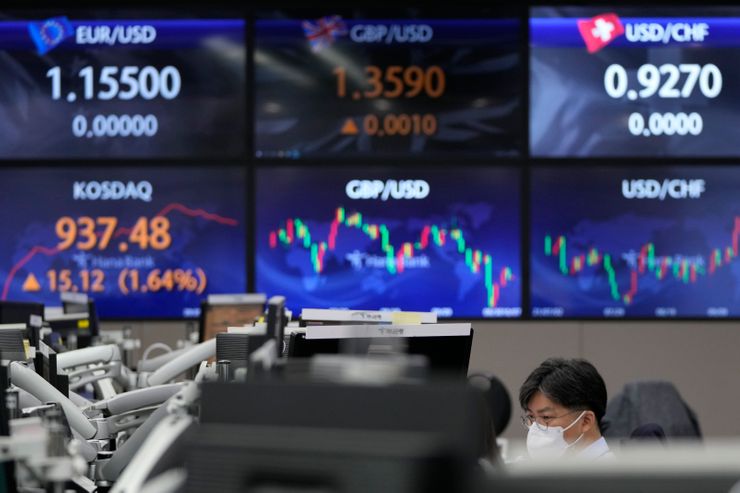
In currency trading, the U.S. dollar inched up to $111.39 Japanese yen from 111.41 yen. The euro rose to $1.1570 from $1.1557.
More News

M.L.B. Playoff Ads With Sydney Sweeney and Megan Fox Draw Backlash
Commercials with Sydney Sweeney promoting a gambling platform and Megan Fox endorsing male enhancement have rankled fans, and even athletes. Who is in charge?

Netflix Hurries to Rewrite Its Narrative With Layoffs and a Sudden Firing
Despite strong revenues and profits, the streaming service cut 1,000 jobs and jettisoned its chief content officer. Drops in the stock price and viewer engagement are to blame.

Why Bad News in the Bond Market May Be Good News for Investors
In the contrarian logic of investing, rising interest rates have made bonds much more attractive, our columnist says.

U.S. Budget Deficit Nears $2 Trillion, a Reality Check for Trump’s Cost Cutting
Higher interest rates are inflating borrowing costs as the Trump administration spends on the Iran war and tariff refunds.

Indonesian Stocks Plunge as MSCI Threatens to Drop Market from Indexes
The potential downgrade by MSCI, an influential index provider, adds to a deepening crisis of investor confidence in the economic policies of President Prabowo Subianto.

Warsh Vows to Tame Inflation as A.I. Delivers ‘Shock’ to Economy
The Federal Reserve chairman stuck to his pledge to avoid providing guidance about the path forward for interest rates, but did nothing to convey an urgency to raise them later this month.

A new railway corridor: How Nanning links Chinese and ASEAN markets
A new railway corridor: How Nanning links Chinese and ASEAN markets

Watch: Did Tesla really just unveil a flying car?
Tesla CEO Elon Musk showcased the vehicle at a facility owned by his SpaceX company, which helped develop the model.

China and Europe are building new connections in aerospace
China and Europe are building new connections in aerospace – from skies to stars. On the one hand, their deep industrial partnership is scaling global civil aviation to new heights. On the other hand, scientific collaboration is opening new possibilities for space exploration and deepening our understanding of the Sun-Earth system.

BizTalk | Exclusive interview with Former PM of Bosnia and Herzegovina
In this episode of BizTalk, CGTN's Guan Xin speaks with Zlatko Lagumdzija, former prime minister of Bosnia and Herzegovina, about China's development and its role in global governance.

When Will the Fed Move on Rates?
Kevin Warsh, the central bank’s chairman, suggested he wouldn’t push to raise borrowing rates this month. But persistent inflation may force the Fed’s hand.

Banks expect to be hit with higher taxes in Budget
Senior banking executives have told the BBC they expect to be "on the menu" in the chancellor's Budget tax later this month.