
Australia marks 26 years since recession with growth data
Sep 6, 2017
Australia's economy has grown for 26 years without a recession, an extraordinary achievement in a volatile world still aching from the global financial crisis
CANBERRA, Australia — Australia's economy has grown for 26 years without a recession, an extraordinary achievement in a volatile world still aching from the global financial crisis.
But many Australians feel they don't share in that prosperity and are going backward financially, a symptom of a hidden driver behind Australia's economic success — population growth.
Data released by the Australian Bureau of Statistics on Wednesday showed that Australia's economy had grown in the three months through June for a 104th quarter without a technical recession, which is defined as consecutive quarters of economic contraction.
The Australian economy grew by 0.8 percent in the latest quarter, faster than the sluggish 0.3 percent in the March quarter, and 1.9 percent for the year.
Half the improvement was due to consumer spending, a consequence of population growth providing more consumers. Increased exports and a surge in government spending also contributed to the stronger result.
Some economists argued after the March quarter that Australia's unbroken recession-free run broke a world record for continuous growth previously held by the Netherlands. But others point to Japan avoiding technical recession for more than 33 years until 1993.
Many economists argue that GDP alone can paint a misleading picture of an economy such as Australia. They also argue that GDP needed to grow faster to deliver wage growth to Australia's expanding ranks of workers.
Commonwealth Bank of Australia senior economist Gareth Aird said in a report in July that some of the weaknesses in the Australian economy were papered over by one of the highest population growth rates in the developed world, mostly generated by immigration. Australia's population grew by 1.55 percent last year.
Annual wage growth is currently at its lowest since Australia's last recession ended in 1991. Underemployment, a measure of people with jobs who want to work more hours, was near a record high, Aird found.
GDP per capita, a measure of the economic growth share for each consumer in an ever-expanding pool of consumers, was the lowest since the global financial crisis.
"Per capita measures of the economy suggest that growth in living standards has stagnated and for some sections of the resident population, in particular younger people, it has gone backward," Aird wrote.
Philip Lowe, governor of the Reserve Bank of Australia, the central bank, said recently that "our strong population growth has flattered our headline growth figures."
A growing population requires more homes and housing construction remained at a high level in the latest quarter data.
The Reserve Bank recently announced that Australia's household debt-to-income ratio had reached an all-time high of 190 percent — one of the highest levels of indebtedness in the world. The Australian rate is continuing to grow faster than wages.
Lowe blamed the trend on escalating real estate prices, a record low base interest rate of 1.5 percent and low wage growth.
Treasurer Scott Morrison on Wednesday noted that payrolls had increased by 0.7 percent in the latest quarter and 2.1 percent for the year. But this reflected more people in jobs as well as higher wages.
"Improving the incomes and wages of ... Australian workers remains our most important challenge," Morrison said. "As the labor market continues to strengthen, we believe wages can be expected to improve."
Australia, like several commodity-exporting countries, has experienced a credit boom to keep pace with housing prices since the financial crisis.
The Swiss-based Bank of International Settlements, which represents 60 central banks, warned in June that Australia's burgeoning household debt was a threat to its continuing economic growth, which is substantially based on household spending.
Sydney University economist Mark Melatos shared concerns that Australians curtailing spending to repay debt could end the economy's extraordinary run of growth.
"It's hard to judge where the tipping point is in terms of debt as a percentage of household income cutting into growth," Melatos said.
"But you'd think it's getting pretty close," he added.
More News

Burnham vows end to 'rip-off parking charges' under new rules
Penalties are seen as too harsh on motorists who are penalised for parking on private land.

Job vacancies fall as small firms cut back on recruitment
Small firms cite labour costs as a key factor in scaling back hiring, the Office for National Statistics says.

Chancellor rejects calls to raise Capital Gains Tax in Budget
Influential Labour figures had been pushing for equalising CGT and income tax, but critics have said this could drive wealthy people out of Britain.

Food aid charity under pressure from fuel costs
FareShare South West says fuel costs are putting immense pressure on work helping thousands in need.

How is the US economy really doing under President Trump?
Ahead of the midterms Trump has boasted about the performance of the US economy. BBC Verify looks at inflation, jobs and economic growth in the country.
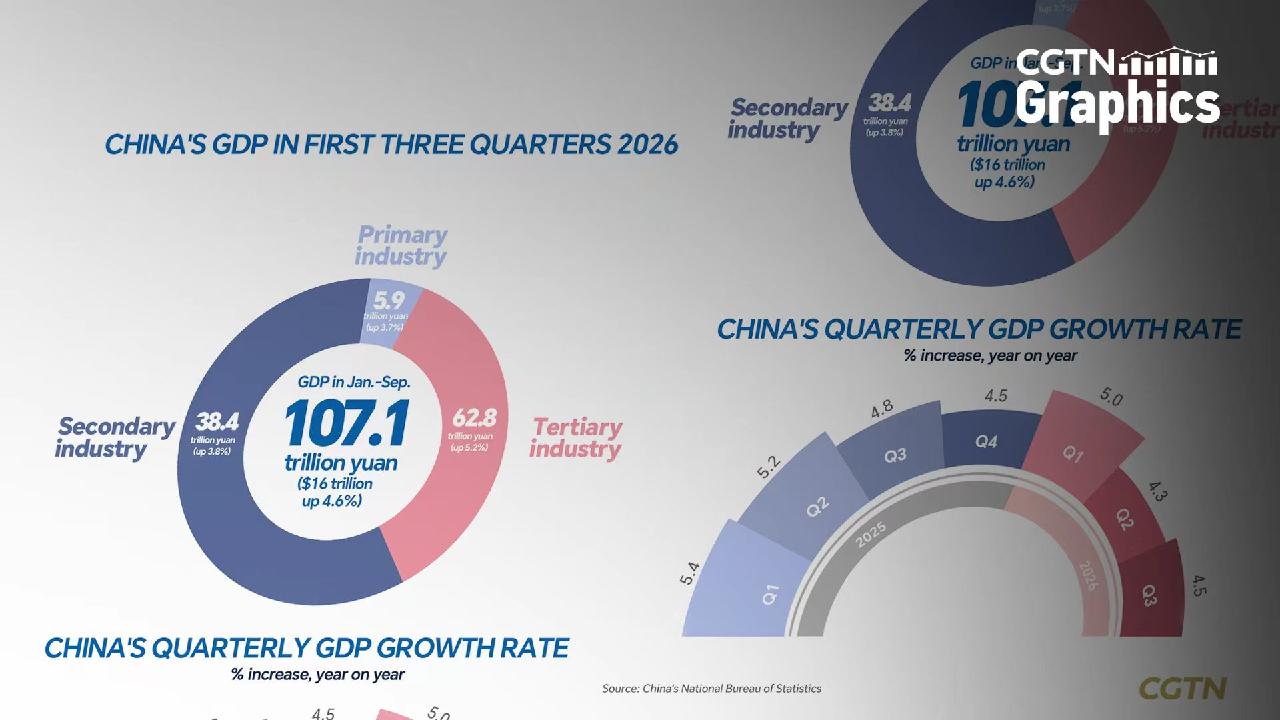
Graphics: China's economy picks up steam in Q3
Graphics: China's economy picks up steam in Q3

The VW Bus, Now Electrified, Keeps on Truckin’
A restored version of Volkswagen’s Flower Power-era Microbus, kitted out by Kindred Motorworks, is aiming for the affluent, while VW’s own E.V. is slow to get moving, much like its forebear.

'I'm fed up of swiping': Why singles now want to meet IRL
The BBC hears from people who think dating events are better value for money than dating apps.

‘A Ticking Time Bomb’: An Economic Crisis Looms in Indonesia
Once a model of economic stability, Indonesia now faces growing hardship at home as President Prabowo Subianto’s policies shake investor confidence.

Black Unemployment Hints at a Job Market in Worse Shape Than It Seems
The Black unemployment rate climbed a percentage point to 7 percent in September, almost double the rate for white workers.

Elon Musk Says He Will Give a SpaceX Share to ‘Every Kid in America’
Anthropic, an A.I. rival to SpaceX, earlier said it would form a “public benefit fund” and other tech moguls have contributed to savings accounts for children.

Christiane Amanpour Says She Is Leaving CNN After 43 Years
The chief international anchor, one of the most famous names in broadcast news, started as an assistant at the network in 1983.