
China faces political conflicts in moves to cut debt burden
Jan 25, 2017
Chinese leaders face conflicting political pressures as they begin tackling a swelling mountain of corporate debt that is fueling fears of a financial crisis
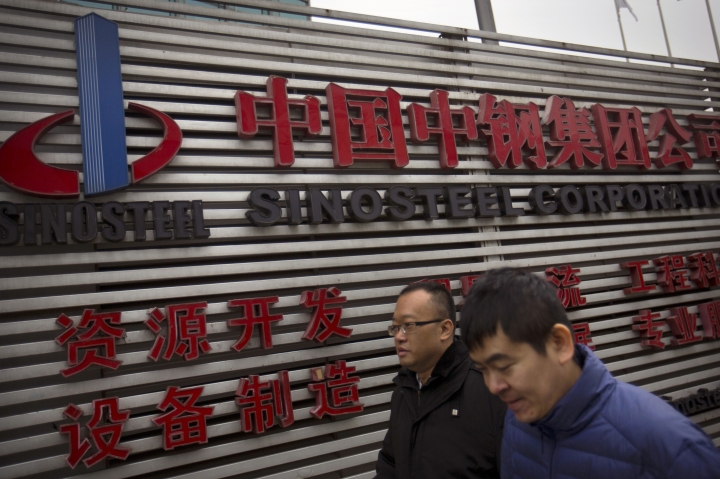
BEIJING — Drowning in debt, metals trader Sinosteel Corp. got an unprecedented lifeline last month from the Chinese government — a multibillion-dollar debt-for-equity rescue that could be the first of many for struggling state-owned companies.
China's economy is still growing relatively quickly, but a prolonged slowdown is raising fears that companies in many industries have borrowed and invested too much, too fast, posing a serious risk for the world's second-largest economy.
The government hailed the Sinosteel deal, in which state-owned banks agreed to accept shares in the company to repay half the 60 billion yuan ($9 billion) it owes, as a model for debt reduction. Analysts are more skeptical. They say such maneuvers are typical of the ruling Communist Party's tendency to avoid bold action and support politically favored state industry.
"They are still tinkering at the edge of the problem instead of tackling it head on," said Mark Williams, chief Asia economist for Capital Economics.
Total debt owed by companies and households in China is estimated by private sector analysts to amount to 250 percent of annual economic output — high for a developing country and close to the levels of the United States and the European Union before the 2008 crisis.
Debt has risen at double-digit annual rates since the crisis as Beijing repeatedly used infusions of credit to shore up economic growth and avoid politically risky job losses.
In 2016, lending grew by 17 to 18 percent, outpacing the rise in savings by China's famously thrifty households, according to Standard & Poor's. It said that leaves banks with slimmer "funding buffers."
Explosive economic growth that peaked at 14.2 percent in 2007 helped China power its way out of previous financial quandaries. That is no longer assured now that growth has tumbled to less than half that level — at 6.7 percent for the first nine months of last year the weakest since 1990.
The bank regulator reported in October that loans on which borrowers have made no payments in 90 days had passed 2 trillion yuan ($300 billion).
That is equivalent to a relatively modest 2.15 percent of total lending, but private sector analysts say the true level is far higher at up to 19 percent, or nearly 18 trillion yuan ($2.5 trillion). They say banks fail to include loans to state companies in their count because they assume the government will bail them out.
A banking crisis like those that hit Japan and South Korea in the 1990s is unlikely because both Chinese lenders and major borrowers are state-owned, so as a last resort, the government could order creditors to keep lending and then replenish their balance sheets, economists say.
That would keep banks solvent, but might divert money from investment in productive companies or from paying for schools, health care and other public services needed in China's rapidly aging society.
"You can get away without a crisis over the next few years, but you won't be able to avoid slower growth," Williams said.
The latest plan for Sinosteel calls for transforming some of its debt into "convertible bonds" that creditors can redeem later for stock, according to Bank of China Ltd., which led a consortium of lenders. It said regulators would press the company for "internal reform."
The business magazine Caixin reported that half of Sinosteel's debt would be turned into such bonds.
Lenders that accept Sinosteel stock still can lose money if its finances fail to improve, said Sheng Hong, director of the Unirule Institute in Beijing, an independent economic research group.
"Banks should have refused the deal right from the start," he said.
The debt dilemma reflects the leadership's conflicting desires for the prosperity that comes from free-market competition and for ensuring state companies will still dominate the economy.
Under President Xi Jinping, the Communist Party has pledged to clear up debt and get banks to finance productive activity instead of subsidizing state companies. But the debt burden has kept rising as Beijing avoided taking painful, decisive action.
Regulators say they will use market forces to force state companies that control industries including steel, utilities, telecoms, airlines, banking and insurance to become more efficient. But they have ruled out allowing any to go bankrupt: The ruling party's latest economic blueprint for 2017 promises "financial stability," which suggests Chinese leaders might be leery of pushing companies so hard they might collapse.
Bailing out companies such as Sinosteel that are deemed strategically important could set back efforts to shrink bloated heavy industries.
A glut of production in steel, aluminum and other industries where supply exceeds demand has led to price-cutting wars and complaints that low-cost Chinese exports are threatening jobs in the United States and Europe.
Instead of state-engineered bailouts, the companies could just sell off equity stakes and use the proceeds to pay debts, Citigroup economists Li-Gang Liu and Xiaowen Jin said in a report.
Sinosteel has operations in mining, steel trading and engineering. It came close to defaulting on a 2 billion yuan ($315 million) bond payment in 2015 before regulators intervened and persuaded creditors to wait.
Bank of China described the Sinosteel debt-for-equity deal as a model for future debt restructuring.
But some companies that get such relief might "lose motivation to improve," said Zhang Yingjie, research director for China Chengxin International Credit Rating Co. "The key lies in how to select the enterprises."
"They are selling this as dealing with the debt problem and creating viable businesses," said Williams, "but it seems to me it is aimed at making sure state-owned firms can continue to dominate."
___
AP researcher Yu Bing contributed.
More News

Paddy Power cuts 1,400 jobs and blames betting tax rises
The government increased taxes on online casino and sports betting in last year's Budget.

Investors in Anticipation Over Musk’s Next Big SpaceX Deal
Ahead of SpaceX’s quarterly earnings report, many on Wall Street are wondering whether Elon Musk will combine it with Tesla.

Bereaved families could face 'unjust' tax bill after civil service pension delays
The chairman of Parliament's Public Accounts Committee says families should not be taxed through no fault of their own.

Trump Announces $8 Billion Plan to Cover Farm Losses
Under the Harvest Fuel Relief program, the Agriculture Department will provide economic aid for farmers hurt by high diesel prices.

Jobless rate falls but small firms cut back hiring
Small firms cite labour costs as a key factor in scaling back hiring, the Office for National Statistics says.

£30 rise in payments for crisis-hit households
More money is made available through a resilience fund for hard-pressed households in Sheffield.

'I'm fed up of swiping': The singles choosing dating events over apps
The BBC hears from people who think dating events are better value for money than dating apps.

Chancellor rejects calls to raise Capital Gains Tax in Budget
Influential Labour figures had been pushing for equalising CGT and income tax, but critics have said this could drive wealthy people out of Britain.

Knicks Ticket Prices Are Soaring After Last Season’s Championship
Knicks tickets have never been cheap, but prices for the first game alone are soaring after last season’s championship — more than a trip to Paris.

How Do Airports Prepare for a Plane Crash? Go Inside JFK’s Disaster Drill.
U.S. airports are required to hold a full-scale disaster drill every three years. Go inside a simulated plane crash at Kennedy Airport last weekend.

Burnham vows end to 'rip-off parking charges' under new rules
The changes come after concerns that penalties issued by private providers are too harsh and leave motorists unfairly punished.

Revolut outage hits 'multiple services' as thousands of users report app issues
Some users of the British neobank reported being unable to make some payments or access funds in its app on Tuesday.