
Global stocks, oil prices sink after grim IMF forecast
Apr 15, 2020
Global stocks and oil prices have sunk after the International Monetary Fund said the world economy will suffer its worst year since the Great Depression of the 1930s due to the coronavirus pandemic
Global stocks and oil prices tumbled Wednesday after the International Monetary Fund said the world's economy will suffer its worst year since the Great Depression of the 1930s due to the coronavirus pandemic.
London and Frankfurt opened down at least 1.5% and benchmarks in Shanghai, Tokyo, Hong Kong and Sydney also declined.
Benchmark U.S. crude lost 79 cents to $19.33 per barrel in electronic trading on the New York Mercantile Exchange, dipping below $20 per barrel after an International Energy Agency report forecast that demand will drop by 9 million barrels per day in 2020, and by 29 million barrels per day in April.
The drop came despite an agreement over the weekend among OPEC and other oil producers to cut output to reflect collapsing demand. The contract fell $2.30, or 10.3%, on Tuesday to close at $20.11.
Brent crude, the standard for international oils, declined $1.60 to $28.00 per barrel in London. It dropped $2.14 the previous session to close at $29.60 a barrel.
The IMF said this year's global economic output will shrink by 3%, a bigger loss than 2009's 0.1% decline during the financial crisis. That was a sharp reverse from the Fund's January forecast of 3.3% growth before the virus prompted governments to shut down factories, travel and other industries.
“The IMF forecast a deep economic winter," said Hayaki Narita of Mizuho Bank in a report. Narita said, however, investors appear to be looking past that to the IMF's prediction of a “spring-back in growth” to 5.8% next year.
The IMF’s chief economist, Gita Gopinath, said the loss to global gross domestic product, the broadest gauge of economic output, could amount to $9 trillion, or more than the economies of Germany and Japan combined.
In early trading, London's FTSE 100 lost 1.5% to 5,706.74 and the DAX in Frankfurt declined 1.6% to 10,523.47. The CAC 40 in France retreated 1.6% to 4,449.63.
On Wall Street, the future for both the benchmark S&P 500 and the Dow industrials sank 1.8%.
On Tuesday, the S&P climbed 3.1%. The index surged 12% last week but is about 16% below its February all-time high.
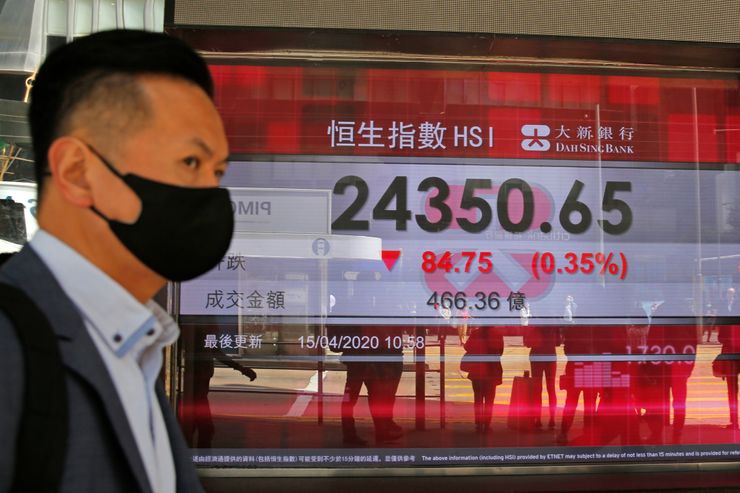
The Shanghai Composite Index lost 0.6% to 2,811.17 and the Nikkei 225 in Tokyo declined 0.5% to 19,550.09. Hong Kong's Hang Seng was off 1.2% at 24,145.34.
The S&P-ASX 200 in Sydney lost 0.4% to 5,466.70 while India's Sensex added 0.9% to 30,982.37. New Zealand advanced 2.5% while Jakarta lost 1.7% and Singapore retreated 1.3%.
Investors are focusing on how and when authorities may begin to ease business shutdowns and limits on people’s movements imposed to slow the spread of the coronavirus.
President Donald Trump has been discussing how to roll back federal social distancing recommendations. U.S. governors are collaborating on plans to reopen their economies in what is likely to be a gradual process to prevent the coronavirus from rebounding.
The discussions follow signs the outbreak may be leveling off in some of the hardest-hit areas, including New York City.
In Italy, Spain and other places around Europe where infections and deaths have begun stabilizing, the process of reopening economies is already underway. Some businesses and industries are being allowed to reopen in a calibrated effort to balance public health and their countries’ economic well-being.
The IMF expects economic contractions this year of 5.9% in the United States, 7.5% in the 19 European countries that share the euro currency, 5.2% in Japan and 6.5% in the United Kingdom. The Fund said China, where the pandemic originated, should eke out 1.2% growth this year, better than some private sector forecasters who expect little to no growth in the world’s second-biggest economy.
China has reopened factories, shops and other businesses after declaring victory over the outbreak but forecasters say it will take months for industries to return to normal output, while exporters will face depressed global demand.
Wall Street expects profits will fall for most companies in the S&P 500. The focus is on what management teams have to say about what profits look like for the rest of the year.
Analysts are forecasting a drop of roughly 10% in earnings per share for S&P 500 companies for the first quarter and 21% for the second quarter.
CURRENCY: The dollar advanced to 107.34 yen from Tuesday's 107.17 yen. The euro retreated to $1.0937 from $1.0981.
More News

Trump Offers Putin Economic Relief in Hopes That Russia Will Return the Favor
The Trump administration is ignoring the will of Congress and waiving new Russia sanctions amid fears that high energy prices will cost Republicans in next month’s elections.

Weak Links Start to Show in A.I. Borrowing
Debt trouble at CoreWeave, Oracle and SoftBank raises questions about whether there are broader problems with the data center build-out.

The Reporter Who Exposed Elizabeth Holmes on Nathan Fielder’s Documentary
Ms. Holmes handed the makers of “You Can See Everything” — and the rest of the world — a microscope with which to observe and dissect her lies.

Can Cereal Be Healthy? Big Companies Are Trying.
As more Americans turn away from the snap, crackle and sugar, the industry is trying to capitalize on our current obsession with wellness.

Low-cost clinic helps pet owners with vet bills
RSPCA Medway West launches its clinic for the pets of people with low incomes.

States Are Stepping Up as the New Antitrust Enforcers
With the Trump administration taking a relaxed approach, attorneys general around the country have ramped up their scrutiny of mergers.

Corporate Tax Revenue Falls Even as Profits Soar Under Trump
The annual decline was about $70 billion. Companies are writing off billions in A.I. investments, taking advantage of tax cuts that President Trump signed into law.

It’s Time to Shop Medicare, and This Year, It’s Extra Important
Be sure to read your mail this fall — big changes to prescription drug plans and Medicare Advantage provider networks are coming, and could cost you more.
Weak Links Start to Show in A.I. Borrowing
Debt trouble at CoreWeave, Oracle and SoftBank raises questions about whether there is broader trouble with the data center build-out.

Call for more food funding due to high living cost
Deputy Louise Doublet does not think the cost of living was considered in the ending of a trial.

Charity reflects on changing needs over 25 years
Help a Guernsey Child says it has provided in excess of £1.2m worth of essential support.

Nightclubs are disappearing - and it's affecting young people
One young person said with no nightlife in their town they cannot "let loose and mess around".