
History points to protracted and tough Brexit negotiations
Mar 30, 2017
The last time Britain held trade talks with the EU, it was to join the bloc _ and it was a frustrating, long and humbling experience for Britain. A look back at those talks highlights some of the challenges Britain faces today.
LONDON — It took Britain more than a decade of trying to join the European club. It's now got just two to get out and strike a new relationship.
If anyone thinks that will be easy for Britain, a look back to its entry half a century ago will show how difficult and protracted talks with the EU can be.
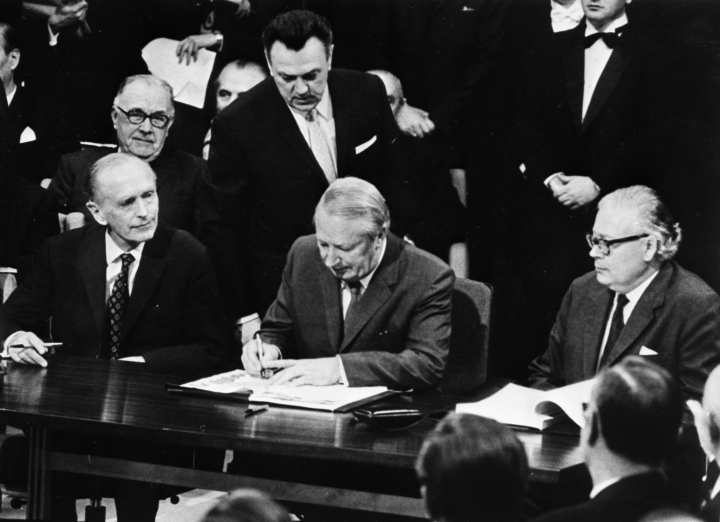
Successive British governments slogged away at trying to convince the original six members — Belgium, France, Italy, Luxembourg, the Netherlands and West Germany — to let it into what was then the European Economic Community. Membership in 1973 took 12 years of on-and-off discussions that at various times humbled the British.
Prime Minister Harold Macmillan got so distraught he confided in his diary in 1963 that "all our policies at home and abroad are in ruins" after French President Charles de Gaulle vetoed Britain's first bid to join. De Gaulle would torpedo Britain's second attempt four years later, too.
"Boy, was it tough," said Piers Ludlow, a historian at the London School of Economics who is a specialist on Britain's postwar relations with Europe.
The past talks highlight some of the challenges Britain faces today. While the international political situation is different, the negotiations promise to be even trickier: with far more EU members involved and more complex and interdependent economies.
British Prime Minister Theresa May on Wednesday formally began the divorce talks with the EU. Her government is hoping to settle the exit terms alongside talks over the creation of a "deep and special partnership." The EU wants to first reach a deal on the exit deal and has insisted that any future relationship must be seen to be inferior to full membership.
Nine months on from the British vote to leave the EU, the two sides are finally setting up their stalls. The past suggests that it will be the British who will have to make the bulk of the concessions.
Ludlow noted that in the early 1960s, Britain thought it would be relatively easy to join because of its status as a top European power — echoing the rhetoric from Brexit proponents today, who argue they'll get a good deal from the EU because the EU has a lot to lose through its strong trade ties.
Instead, the years of discussions showed the Europeans, and the French in particular, to be stubborn negotiators.
"For them, of course it is rather harder to reach a consensus opinion because they've got their own national interests and they've got to reach agreement among the six," Geoffrey Rippon, Britain's chief negotiator during the early 1970s, had said.
Now there are 27 countries to negotiate with.
And once again, there are concerns on the British side that the French will prove the most intransigent. As Rippon said all those years ago: "They're hard bargainers."
The EU side will be more efficient today, as it has a more powerful executive Commission to lead the day-to-day talks. The Commission has built up decades of experience on trade negotiations, handling them on behalf of all member states.
But even so, it will take time for all the EU member states to agree on each point of negotiation. Canada's recently concluded trade deal with the bloc took seven years.
"Anyone involved in enlargement/trade deals over the past 60 years can tell you, it's not a fun beast to negotiate with," Ludlow said of the EU. "It's like a ponderous giant; that's the nature of the beast."
Michel Barnier, a former French diplomat, will be the EU's lead Brexit negotiator and is already setting the terms of the agenda.
While admitting that the EU hopes to get a new trade deal within the two years, Barnier has insisted that discussions cannot proceed until Britain settles its multibillion exit bill — what it owes on such things as pension obligations to EU staffers and budgetary contributions it has already committed to.
And there's more than just trade to be discussed, with topics ranging from security cooperation to airlines' access to European skies.
Ludlow says the cost of the divorce bill has added "a fraught element" in much the same way financial matters did decades ago when Britain tried to join. Back then, Britain fought hard not to be one of the largest net contributors to the European budget but eventually conceded defeat to get the green light on its accession.
"The question of what the divorce settlement will be looks likely to be one of the hardest elements of the negotiations," Ludlow said.
Another key lesson from the past is that Britain should park any notion that it can exploit differences among the other EU 27 member states. Jean-Claude Juncker, the president of the EU Commission, warned recently that the old British imperial tactic of 'divide-and-rule' won't work.
"There will be a single negotiating line and a very strong desire for negotiators to stick together even if Berlin has a different view from Madrid or Warsaw," said Ludlow, author of 'Dealing with Britain: The Six and the First U.K. Application to the EEC.'
"If you go back to the 1960s, British negotiators found it massively frustrating," he added. Every time the British made a proposal, Europe's representatives left the room to find a unanimous position.
In many ways, the backdrop now is more difficult than it was back in the 1960s and 1970s. There are 21 more members to negotiate with and each one has a veto; the importance of Europe to member states is more pronounced after another four decades of integration; and the EU faces a crisis of confidence following years of economic turmoil in some of the countries that use the euro.
"There's now even more at stake," said Ludlow. "The EU is also conscious of its own fragility and has incentives to avoid the British disrupting the process on the way out."
Would de Gaulle be surprised at the turn of events?
Probably 'non.'
More News

Paddy Power cuts 1,400 jobs and blames betting tax rises
The government increased taxes on online casino and sports betting in last year's Budget.

Investors in Anticipation Over Musk’s Next Big SpaceX Deal
Ahead of SpaceX’s quarterly earnings report, many on Wall Street are wondering whether Elon Musk will combine it with Tesla.

Jobless rate falls but small firms cut back hiring
Small firms cite labour costs as a key factor in scaling back hiring, the Office for National Statistics says.

£30 rise in payments for crisis-hit households
More money is made available through a resilience fund for hard-pressed households in Sheffield.

'I'm fed up of swiping': The singles choosing dating events over apps
The BBC hears from people who think dating events are better value for money than dating apps.

Chancellor rejects calls to raise Capital Gains Tax in Budget
Influential Labour figures had been pushing for equalising CGT and income tax, but critics have said this could drive wealthy people out of Britain.

Trump Announces $8 Billion Plan to Cover Farm Losses
Under the Harvest Fuel Relief program, the Agriculture Department will provide economic aid for farmers hurt by high diesel prices.

Knicks Ticket Prices Are Soaring After Last Season’s Championship
Knicks tickets have never been cheap, but prices for the first game alone are soaring after last season’s championship — more than a trip to Paris.

How Do Airports Prepare for a Plane Crash? Go Inside JFK’s Disaster Drill.
U.S. airports are required to hold a full-scale disaster drill every three years. Go inside a simulated plane crash at Kennedy Airport last weekend.

Burnham vows end to 'rip-off parking charges' under new rules
The changes come after concerns that penalties issued by private providers are too harsh and leave motorists unfairly punished.

Revolut outage hits 'multiple services' as thousands of users report app issues
Some users of the British neobank reported being unable to make some payments or access funds in its app on Tuesday.

What is the Budget and what could be in it?
Chancellor John Healey will set out his plans for UK taxes on 28 October.