
Islamic world unites to aid desperately poor Afghanistan
Dec 19, 2021
Multiple foreign ministers are warning that the economic collapse of Afghanistan would have a “horrendous” impact on the region and the world
ISLAMABAD (AP) — The economic collapse of Afghanistan, already teetering dangerously on the edge, would have a “horrendous” impact on the region and the world, successive speakers warned Sunday at the start of a one-day summit of foreign ministers from dozens of Islamic countries.
The hastily called meeting of the Organization of Islamic Cooperation in Islamabad brought together dozens of foreign ministers with the special representatives on Afghanistan of major powers, including China, the U.S. and Russia.
The gathering also included the U.N. undersecretary general on humanitarian affairs s well as the president of the Islamic Development Bank Muhammad Sulaiman Al Jasser, who offered several concrete financing proposals. He said the IDB can manage trusts that could be used to move money into Afghanistan, jumpstart businesses and help salvage the deeply troubled economy.
The dire warnings called for the U.S. and other nations to ease sanctions, including the release upward of $10 billion in frozen funds following the Taliban takeover of Kabul on Aug. 15.
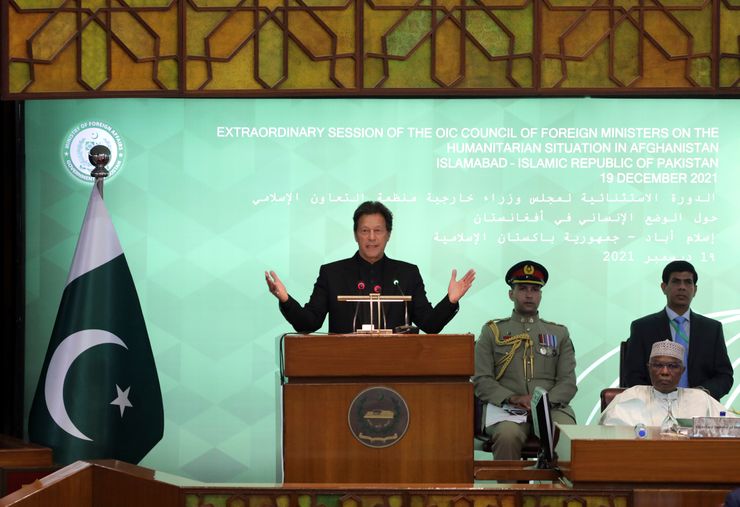
Speakers also called for a quick opening of the country's banking system and collectively, with the United Nations and international banking institutions, assistance to Afghanistan. Pakistan's Prime Minister Imran Khan directed his remarks to the U.S., urging Washington to drop preconditions to releasing desperately needed funds and restarting Afghanistan's banking systems.
Khan seemed to offer Taliban a pass on the limits on education for girls, urging the world to understand “cultural sensitivities” and saying human rights and women's rights meant different things in different countries. Still other speakers, including the OIC chairman Hussain Ibrahim Taha, emphasized the need for the protection of human rights, particularly those of women and girls.
The new Taliban rulers' acting Foreign Minister Amir Khan Muttaqi was in attendance in the grand hall of the Pakistani Parliament, where dozens of foreign ministers from many of the 57-nation OIC had gathered.
“This gathering is about the Afghan people,” said Pakistani Foreign Minister Shah Mahmood Qureshi, who warned that without immediate aid, Afghanistan was certain to collapse. He said it would have “horrendous consequences,” not just in Afghan lives lost to starvation and disease, but would most certainly result in a mass exodus of Afghans. Chaos would spread, he predicted, and allow terrorism and the drug trade to flourish.
Martin Griffiths, the U.N. undersecretary for humanitarian affairs and emergency relief coordinator, warned that Afghanistan will not survive on donations alone. He urged donor countries to show flexibility, allowing their money to pay salaries of public sector workers and support “basic services such as health, education, electricity, livelihoods, to allow the people of Afghanistan some chance to get through this winter and some encouragement to remain home with their families."
Beyond that, Griffiths said, “we need constructive engagement with the de facto authorities to clarify what we expect from each other.”
Afghanistan’s teetering economy, he added, requires decisive and compassionate action, or "I fear that this fall will pull down the entire population."
Griffiths said families simply do not have the cash for everyday purchases like food and fuel as prices soar. The cost of fuel is up by around 40%, and most families spend 80% of their money just to buy food.
He rattled off a number of stark statistics.
“Universal poverty may reach 97% of the population of Afghanistan. That could be the next grim milestone,” he warned. “Within a year, 30% of Afghanistan’s GDP (gross domestic product) could be lost altogether, while male unemployment may double to 29%."
Next year the U.N. would be asking for $4.5 billion in aid for Afghanistan - it's single largest humanitarian aid request, he said.
In what appeared to be a message to the Taliban delegation, Qureshi and subsequent speakers, including Taha, emphasized the protection of human rights, particularly those of women and girls.
In an interview with The Associated Press last week, Muttaqi said that Afghanistan’s new rulers were committed to the education of girls and women in the workforce.
Yet four months into Taliban rule, girls are not allowed to attend high school in most provinces and though women have returned to their jobs in much of the health care sector, many female civil servants have been barred from coming to work.
Meanwhile, Qureshi said he wanted to see the summit end with concrete solutions to help Afghanistan and its people. He called for the summit to pledge and channel aid to Afghanistan; increase investment bilaterally or through the OIC in education, health, technical and vocational skills; and to establish a group of experts from the OIC, the United Nations, the Islamic Development Bank and others to help Afghanistan “access legitimate banking services and ease the serious liquidity challenges of the Afghan people.”
He also called for participants to focus on food security, invest in capacity building inside Afghanistan to fight terrorism and the burgeoning drug trafficking.
“Finally, engage with Afghan authorities to help meet the expectations of the international community, in particular regarding political and social inclusivity, respect for human rights, especially the rights of women and girls and combating terrorism,” he said,
More News

M.L.B. Playoff Ads With Sydney Sweeney and Megan Fox Draw Backlash
Commercials with Sydney Sweeney promoting a gambling platform and Megan Fox endorsing male enhancement have rankled fans, and even athletes. Who is in charge?

Netflix Hurries to Rewrite Its Narrative With Layoffs and a Sudden Firing
Despite strong revenues and profits, the streaming service cut 1,000 jobs and jettisoned its chief content officer. Drops in the stock price and viewer engagement are to blame.

Why Bad News in the Bond Market May Be Good News for Investors
In the contrarian logic of investing, rising interest rates have made bonds much more attractive, our columnist says.

U.S. Budget Deficit Nears $2 Trillion, a Reality Check for Trump’s Cost Cutting
Higher interest rates are inflating borrowing costs as the Trump administration spends on the Iran war and tariff refunds.

Indonesian Stocks Plunge as MSCI Threatens to Drop Market from Indexes
The potential downgrade by MSCI, an influential index provider, adds to a deepening crisis of investor confidence in the economic policies of President Prabowo Subianto.

Warsh Vows to Tame Inflation as A.I. Delivers ‘Shock’ to Economy
The Federal Reserve chairman stuck to his pledge to avoid providing guidance about the path forward for interest rates, but did nothing to convey an urgency to raise them later this month.

Watch: Did Tesla really just unveil a flying car?
Tesla CEO Elon Musk showcased the vehicle at a facility owned by his SpaceX company, which helped develop the model.

When Will the Fed Move on Rates?
Kevin Warsh, the central bank’s chairman, suggested he wouldn’t push to raise borrowing rates this month. But persistent inflation may force the Fed’s hand.

Banks expect to be hit with higher taxes in Budget
Senior banking executives have told the BBC they expect to be "on the menu" in the chancellor's Budget tax later this month.

Feel Like You’re Overpaying for Hotels? Blame Expedia, a New Lawsuit Says.
The booking giant is accused of breaking federal antitrust laws and forcing millions of customers to overspend on stays by as much as 30 percent.

Tesla Debuts 2026 Roadster ‘Flying’ Electric Sports Car
Elon Musk’s company and other automakers, like Jaguar and Bentley, are trying to sell very expensive electric cars to people who usually prefer gasoline-fueled luxury and performance.

Trump Hasn’t Lowered Drug Prices for These Voters
President Trump has been promoting his efforts to reduce drug prices, but many Americans have not seen relief from rising costs for prescriptions and insurance premiums.