
Japan stocks fall after economy contracts, other markets up
Aug 17, 2020
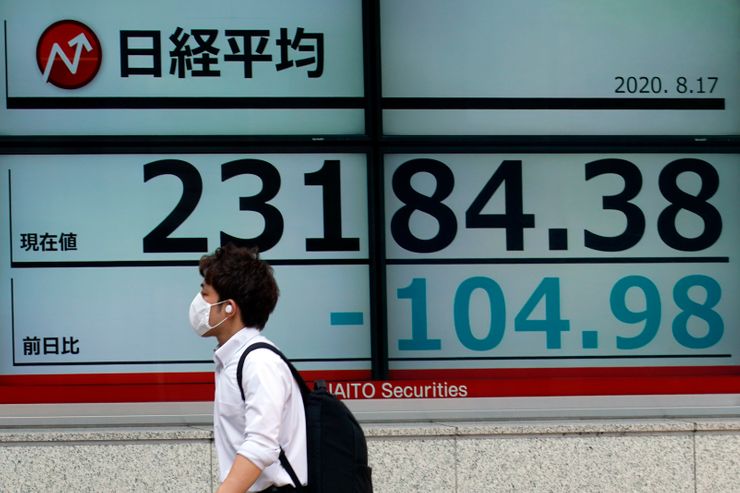
Shares fell in Tokyo s have sunk while other global markets and U.S. futures gained after Japan reported a record economic contraction amid the coronavirus pandemic
BEIJING (AP) — Japanese stocks sank while other global markets and U.S. futures gained Monday after Japan reported a record economic contraction amid the coronavirus pandemic.
The Nikkei 225 in Tokyo fell 0.8% to 23,096.75 after data showed the world’s third-largest economy shrank 27.8% from a year earlier in the three months ending in June. That was bigger than the deepest decline during 2008-09 financial crisis.
“The road ahead looks choppy as a resurgence in Covid cases will weigh on domestic and overseas spending,” said Stefan Angrick of Oxford Economics in a report.
In early trading, the FTSE 100 in London gained 0.1% to 6,097.97. The DAX in Frankfurt was up 0.1% at 12,913.62 and France's CAC 40 added less than 0.1% to 4,964.88.
On Wall Street, futures for the benchmark S&P 500 Index and for the Dow Jones Industrial Average were up 0.3%.
The S&P 500 ended last week little changed. The index declined less than 0.1% while the Dow gained 0.1%. The The Nasdaq composite dipped 0.2%.
In Asia, the Shanghai Composite Index rose 2.3% to 3,436.80 and Hong Kong’s Hang Seng gained 0.7% to 25,347.34. South Korean markets were closed for a holiday.
The S&P-ASX 200 in Sydney shed 0.8% to 6,076.40 while India's Sensex advanced 0.3% to 37,994.08. New Zealand advanced while Singapore and Bangkok declined.
Bangkok's main index lost 0.5% after Thailand reported its economy shrank 12.2% from a year earlier in the quarter ending in June. That was its worst performance since 1998 during the Asian financial crisis.
Investors in Asia were looking ahead to central bank meetings this week in China, Indonesia and the Philippines, with few other market-moving events in sight.
In the United States, economists say consumer spending could be under more pressure after government aid including additional $600 weekly unemployment benefits expired. Investors are counting on Washington for another economic lifeline, but legislators are far apart on a possible package.
In energy markets, benchmark U.S. crude gained 20 cents to $42.21 per barrel in electronic trading on the New York Mercantile Exchange. The contract slipped 23 cents on Friday to settle at $42.01. Brent crude, the standard for international oil prices, added 17 cents to $44.97 per barrel in London. It 16 cents the previous session to $44.80.
The dollar declined to 106.47 yen from Friday’s 106.59 yen. The euro gained to $1.1835 from $1.1843.
More News

The Reporter Who Exposed Elizabeth Holmes on Nathan Fielder’s Documentary
Ms. Holmes handed the makers of “You Can See Everything” — and the rest of the world — a microscope with which to observe and dissect her lies.

Corporate Tax Revenue Falls Even as Profits Soar Under Trump
The annual decline was about $70 billion. Companies are writing off billions in A.I. investments, taking advantage of tax cuts that President Trump signed into law.

Can Cereal Be Healthy? Big Companies Are Trying.
As more Americans turn away from the snap, crackle and sugar, the industry is trying to capitalize on our current obsession with wellness.

It’s Time to Shop Medicare, and This Year, It’s Extra Important
Be sure to read your mail this fall — big changes to prescription drug plans and Medicare Advantage provider networks are coming, and could cost you more.

Weak Links Start to Show in A.I. Borrowing
Debt trouble at CoreWeave, Oracle and SoftBank raises questions about whether there is broader trouble with the data center build-out.

Call for more food funding due to high living cost
Deputy Louise Doublet does not think the cost of living was considered in the ending of a trial.

Charity reflects on changing needs over 25 years
Help a Guernsey Child says it has provided in excess of £1.2m worth of essential support.

Nightclubs are disappearing - and it's affecting young people
One young person said with no nightlife in their town they cannot "let loose and mess around".

M.L.B. Playoff Ads With Sydney Sweeney and Megan Fox Draw Backlash
Commercials with Sydney Sweeney promoting a gambling platform and Megan Fox endorsing male enhancement have rankled fans, and even athletes. Who is in charge?

Netflix Hurries to Rewrite Its Narrative With Layoffs and a Sudden Firing
Despite strong revenues and profits, the streaming service cut 1,000 jobs and jettisoned its chief content officer. Drops in the stock price and viewer engagement are to blame.

Why Bad News in the Bond Market May Be Good News for Investors
In the contrarian logic of investing, rising interest rates have made bonds much more attractive, our columnist says.

U.S. Budget Deficit Nears $2 Trillion, a Reality Check for Trump’s Cost Cutting
Higher interest rates are inflating borrowing costs as the Trump administration spends on the Iran war and tariff refunds.