
Lebanon president leaves with no replacement, crisis deepens
Oct 30, 2022
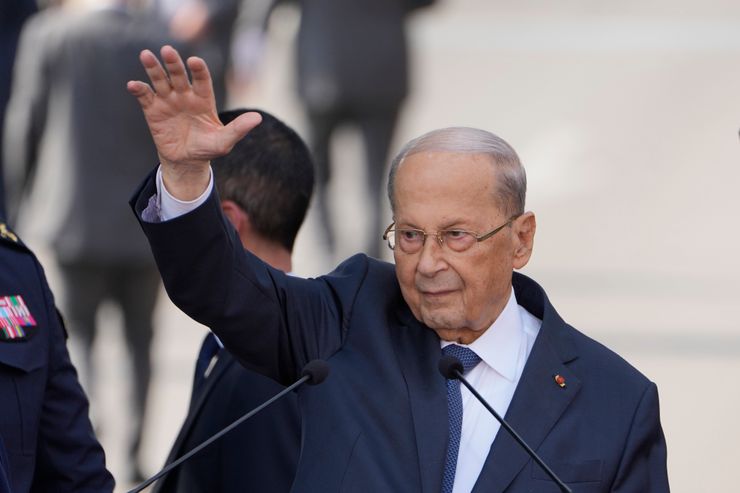
President Michel Aoun has left Lebanon’s presidential palace, marking the end of his six-year term without a replacement
BEIRUT (AP) — President Michel Aoun left Lebanon's presidential palace Sunday, marking the end of his six-year term without a replacement, leaving the small nation in a political vacuum that is likely to worsen its historic economic meltdown.
As Aoun’s term ends, the country is being run by a caretaker government after Prime Minister-designate Najib Mikati failed to form a new Cabinet following May 15 parliamentary elections. Aoun and his supporters warn that such a government doesn't have full power to run the country, saying that weeks of “constitutional chaos” lay ahead.
In a speech outside the palace, Aoun told thousands of supporters that he has accepted the resignation of Mikati's government. The move is likely to further deprive the caretaker administration of legitimacy and worsen existing political tensions in the country.
Mikati responded shortly afterward with a statement from his office saying that his government will continue to perform its duties in accordance with the constitution.
Many fear that an extended power vacuum could further delay attempts to finalize a deal with the International Monetary Fund that would provide Lebanon with some $3 billion in assistance, widely seen as a key step to help the country climb out of a three-year financial crisis that has left three quarters of the population in poverty.
While it's not the first time that Lebanon’s parliament has failed to appoint a successor by the end of the president’s term, this will be the first time that there will be both no president and a caretaker cabinet with limited powers.
Lebanon’s constitution allows the cabinet in regular circumstances to run the government, but is unclear whether that applies to a caretaker government.
Wissam Lahham, a constitutional law professor at St. Joseph University in Beirut told The Associated Press that in his view, the governance issues the country will face are political rather than legal.
Although the constitution “doesn’t say explicitly that the caretaker government can act if there is no president, logically, constitutionally, one should accept that because… the state and institutions should continue to function according to the principle of the continuity of public services,” he said.
Lebanese are deeply divided over Aoun, an 87-year-old Maronite Christian and former army commander, with some seeing him as a defender of the country’s Christian community and a leading figure who tried to seriously fight corruption in Lebanon. His opponents criticize him for his role in the 1975-90 civil war and for his shifting alliances, especially with the Iran-backed Hezbollah, the country’s most powerful military and political force. He has also come under fire for grooming his son-in-law to replace him, and many blame him for the economic crisis that is rooted in decades of corruption and mismanagement.
Aoun, Lebanon’s 13th president since the country’s independence from France in 1943, saw Beirut’s historic relations with oil-rich gulf nations deteriorate because of Hezbollah’s powers and one of the world’s largest non-nuclear explosions at Beirut’s port in August 2020 that killed more than 200.
Aoun blasted his political opponents and said that they prevented him from bringing to justice central bank governor Riad Salameh, who is being investigated in several European countries, including Switzerland, France, Luxembourg and Liechtenstein for alleged money laundering and embezzlement.
“I leave a country that is robbed,” Aoun said, adding that all Lebanese were hurt by losing their life savings in local banks. He added that some politicians prevented the investigation into the port blast.
Aoun, who blamed his political rivals and others for the crisis except for members of his political party, later left the palace and headed to his residence in Beirut's northern suburb of Rabieh.
Aoun's biggest achievement came last week. He signed a U.S.-mediated maritime border agreement with Israel that Beirut hopes will lead to gas exploration in the Mediterranean. That will presumably help Lebanon come out of its economic crisis that has been described by the World Bank as one of the worst the world has witnessed since the 1850s.
Parliament has held four sessions since late September to elect a president but no candidate was able to get the two-thirds majority of the vote needed. As in previous votes, parliamentary blocs will have to agree on a consensus candidate for the country’s top post as no alliance within the legislature controls majority seats.
Aoun himself was elected in 2016 after a more than two-year vacuum. Despite Hezbollah’s support then, Aoun was only elected after he received the backing of the bloc of his main rivals of the Christian Lebanese Forces Party as well as the bloc of former Prime Minister Saad Hariri.
Under Lebanon’s power-sharing agreement, the president has to be a Maronite Christian, the parliament speaker a Shiite and the prime minister a Sunni Muslim. Cabinet and government seats are equally divided between Muslims and Christians. Christians, Sunnis and Shiites each make about a third of Lebanon’s 5 million people.
Since the economic meltdown began with nationwide protests in October 2019, Lebanon’s political class — which has ruled since the end of the civil war — has resisted reforms demanded by the international community that could help secure billions of dollars in loans and investments.
Talks between Lebanon’s government and the IMF that began in May 2020 and reached a staff-level agreement in April have made very little progress.
The Lebanese government has implemented few of the IMF’s demands from the agreement, which are mandatory before finalizing a bailout program. Among them are restructuring Lebanon’s ailing financial sector, implementing fiscal reforms, restructuring external public debt and putting in place strong anti-corruption and anti-money laundering measures.
“The prospects of an IMF deal were already dim before the upcoming power vacuum and departure of Aoun,” said Nasser Saidi, an economist and former Minister of Economy. “There is no political will or appetite for undertaking reforms.”
“Aoun’s departure is simply another nail in the coffin,” he said. “It does not change the fundamentals of a dysfunctional failed state and totally ineffective polity.”
More News

AI giant Anthropic sees revenue surge ahead of stock market listing
It comes as some investors have become concerned about the amount of money being spent on AI infrastructure.

Energy Department Order Takes Aim at Mid-Atlantic Blackout Risk
The order as a precaution allows grid operators to use backup generation this week. There were no widespread outages reported.

How backlash against data centres could shape the US midterm elections
Democrats and Republicans alike are coming out against data centre development, amid growing backlash across the US.

How a Chinese-made toy gets to a US retailer
With Christmas on the horizon, we trace children's toys from factories in China to US shelves.

How much is the minimum wage?
What are the National Minimum Wage and the National Living Wage, and how much are they worth?

Battle Over the Pierre Ends in Defeat for the Buyer Pushed by Lutnick
Motasem Khashoggi, who hails from a prominent Saudi family, missed a Tuesday deadline to deliver a $100 million deposit to purchase the Manhattan landmark.

What Is Starshield, SpaceX’s Military-Grade Satellite Internet Service Ukraine Relies On?
For years, Ukraine’s armed forces have relied on satellite communication services developed by Elon Musk’s SpaceX. Recent restrictions have hampered its war effort.

Why Trump’s Russian Diesel Deal Is Unlikely to Lower Fuel Costs
President Trump’s deal with Russia will probably not lower diesel prices that have soared because of his war with Iran and Ukrainian attacks on Russian refineries.

Higher Energy Prices Pushed U.S. Inflation Up to 3.7% Ahead of Midterm Elections
September’s Consumer Price Index report will keep pressure on President Trump and the Federal Reserve to tame intensifying price pressures.

Surging Inflation Complicates Trump’s Final Push to Sell Voters on Strong Economy
The final inflation report before the 2026 election — showing price increases and stagnant wages — spelled bad political news for the White House.

Attacks on Ships in Strait of Hormuz Escalate Sharply
In a volatile moment in the region, a significant increase in attacks on vessels passing through the vital waterway is raising alarm.

Drop-off charges at UK airports to be reviewed after sharp increase
Confirming the review, the government said it was "vital to ensure travel remains accessible and that passengers are treated fairly".