
Russian delegation in Syria to expand trade, economic ties
Sep 7, 2020
Russia's deputy prime minister says a senior Russian delegation in Damascus has discussed the expansion of economic and trade cooperation between the two countries to circumvent U.S. sanctions
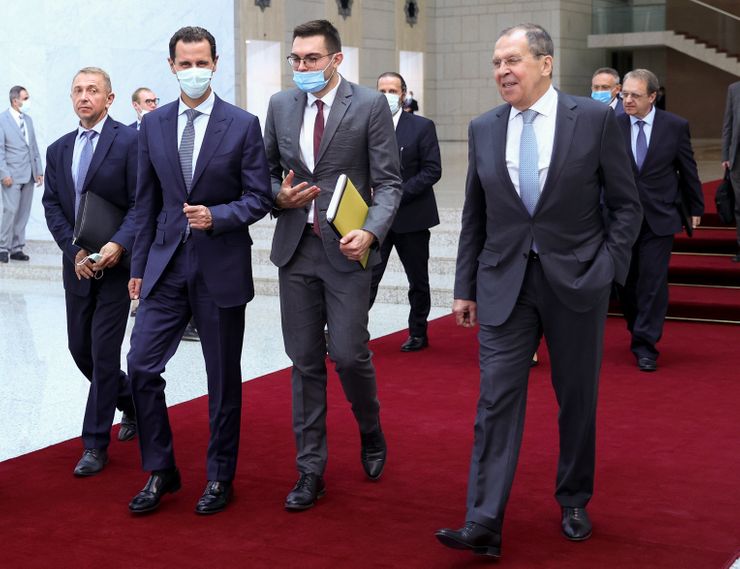
DAMASCUS, Syria (AP) — Russia and Syria plan to sign an economic pact before the end of the year that is partly aimed at circumventing U.S. sanctions, Russia's deputy prime minister said Monday as he led a high-level delegation on a visit to Damascus.
Yuri Borisov said the Russian side is expecting to sign the pact on his next visit in December, adding that it includes more than forty new projects in the energy sector, reconstruction of a number of power stations and offshore oil extraction.
The agreement, he added, would “outline a new framework for trade and economic ties between the two countries for the coming years" while providing relief from U.S. sanctions, which he said were “strangling” the Syrian people.
Borisov spoke at a joint press conference with Syrian Foreign Minister Walid al-Moallem in Damascus after the delegation met with Syrian President Bashar Assad.
Syria faces an unprecedented economic crisis after nearly a decade of civil war and Western sanctions. The economic and financial situation has been worsened by the financial crisis in neighboring Lebanon, Syria's main link with the outside world and where many Syrians have their money. Syria is also grappling with a coronavirus outbreak.
Russian Foreign Minister Sergey Lavrov, who is visiting Damascus for the first time since 2012, also attended the news conference.
Russia has been a close ally of Assad in Syria’s devastating nine-year civil war, lending his government vital military, economic and political support. Russian troops have been fighting alongside Syrian government forces since 2015, and President Vladimir Putin has visited the war-torn country twice, including in January this year.
With the help of Russia, as well as regional ally Iran and its proxy Lebanese militia Hezbollah, Assad has largely succeeded in crushing the armed rebellion against him. The rebels are confined to the northern Idlib province, where a truce has been in place for months.
But Syria has been ruined, the economy has spiraled out of control, and the country remains divided. Turkey-backed forces control a sliver of territory along the border, and U.S.-backed Kurdish forces control an oil-rich area in the northeast.
“We have to admit that most of the areas rich in oil and gas are outside the control of the Syrian government,” Borisov said Monday. “This fact prevents the Syrian government from trading in oil, given that it is an important source of revenue."
“The same applies to agricultural lands," he added. "After Syria used to export grain, it now imports it. ... This harms food security.”
Borisov blamed the United States for the economic deterioration in Syria, which risks reversing the government's recent military gains, calling U.S. policies “unconstructive.”
“The most important reason for the tragic situation in Syria is the devastating situation of the United States of America, in addition to the Kurds’ unwillingness to communicate with Damascus and hand over control to the legitimate government over agricultural areas and oil fields,” Borisov said.
Lavrov also criticized U.S. and Western sanctions on Syria, saying they are “trying to strangle the Syrian people.”
“Our visit to Syria focuses on the prospect of cooperation to develop relations between the two countries in light of new developments in the region," he said.
The Syrian pro-government Al-Watan newspaper earlier quoted Syria's ambassador to Russia, Riad Haddad, as saying that the Russian delegation's visit “is of special importance, given the political and economic files that will be discussed." Those include progress by a committee discussing possible amendments to the Syrian constitution and Western sanctions on Syria, as well as efforts to fight terrorism.
Talks between government, opposition and civil society delegations resumed in Geneva late last month on a possible new constitution for the country. The U.N.'s envoy for Syria, Geir Pedersen, has called the talks a prospective “door-opener” to a final resolution of Syria’s long-running conflict.
The pandemic forced the postponement of an earlier meeting in March.
More News

The Reporter Who Exposed Elizabeth Holmes on Nathan Fielder’s Documentary
Ms. Holmes handed the makers of “You Can See Everything” — and the rest of the world — a microscope with which to observe and dissect her lies.

Corporate Tax Revenue Falls Even as Profits Soar Under Trump
The annual decline was about $70 billion. Companies are writing off billions in A.I. investments, taking advantage of tax cuts that President Trump signed into law.

Can Cereal Be Healthy? Big Companies Are Trying.
As more Americans turn away from the snap, crackle and sugar, the industry is trying to capitalize on our current obsession with wellness.

It’s Time to Shop Medicare, and This Year, It’s Extra Important
Be sure to read your mail this fall — big changes to prescription drug plans and Medicare Advantage provider networks are coming, and could cost you more.

Weak Links Start to Show in A.I. Borrowing
Debt trouble at CoreWeave, Oracle and SoftBank raises questions about whether there is broader trouble with the data center build-out.

Call for more food funding due to high living cost
Deputy Louise Doublet does not think the cost of living was considered in the ending of a trial.

Charity reflects on changing needs over 25 years
Help a Guernsey Child says it has provided in excess of £1.2m worth of essential support.

Nightclubs are disappearing - and it's affecting young people
One young person said with no nightlife in their town they cannot "let loose and mess around".

M.L.B. Playoff Ads With Sydney Sweeney and Megan Fox Draw Backlash
Commercials with Sydney Sweeney promoting a gambling platform and Megan Fox endorsing male enhancement have rankled fans, and even athletes. Who is in charge?

Netflix Hurries to Rewrite Its Narrative With Layoffs and a Sudden Firing
Despite strong revenues and profits, the streaming service cut 1,000 jobs and jettisoned its chief content officer. Drops in the stock price and viewer engagement are to blame.

Why Bad News in the Bond Market May Be Good News for Investors
In the contrarian logic of investing, rising interest rates have made bonds much more attractive, our columnist says.

U.S. Budget Deficit Nears $2 Trillion, a Reality Check for Trump’s Cost Cutting
Higher interest rates are inflating borrowing costs as the Trump administration spends on the Iran war and tariff refunds.