
Russian stock market opens with major limits after a month
Mar 24, 2022
The Russian stock market has opened for limited trading under heavy restrictions for the first time since Moscow invaded Ukraine
NEW YORK (AP) — The Russian stock market opened Thursday for limited trading under heavy restrictions for the first time since Moscow invaded Ukraine, coming almost a month after prices plunged and the market was shut down as a way to insulate the economy.
Trading of a limited number of stocks, including energy giants Gazprom and Rosneft, took place under curbs meant to prevent a repeat of the massive selloff on Feb. 24 that came in anticipation of Western economic sanctions.
The significant restrictions on trading Thursday underlined the pressure Russia's financial system is under despite central bank efforts to curb market plunges. Foreigners could not sell and traders were barred from short selling — or betting prices will fall — while the government has said it will spend $10 billion on shares in coming months, a move that should support prices.
The benchmark MOEX index gained 6.5% as some companies partially recovered losses from the plunge on the day of the invasion. Airline Aeroflot bucked the positive trend by losing 10.7% — not a surprise because it has suspended all international flights after the U.S., European Union and others banned Russian planes in their airspaces.
A U.S. official called the severely restricted market a “charade," with only some listed shares trading and Russia making clear it would “pour government resources into artificially propping up the shares of companies that are trading."
“This is not a real market and not a sustainable model, which only underscores Russia’s isolation from the global financial system," Daleep Singh, a deputy national security and economic adviser to President Joe Biden, said in a statement.
Restrictions like shutting down and restricting the stock market are among those that Russia has taken to shore up the financial system against utter collapse, but they also close off the economy to trade and investment that could fuel growth.
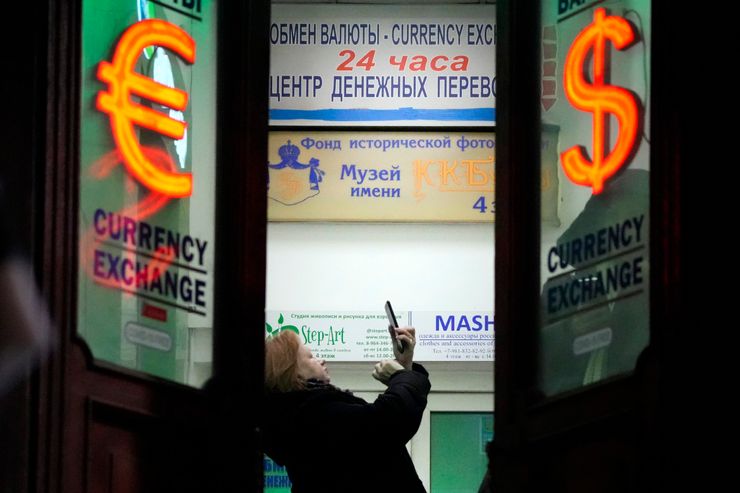
The economic turmoil in Russia from sanctions and the war has been severe. Hundreds of U.S., European and Japanese companies have pulled out of Russia. There have been bank runs and panic buying of sugar and other staples. The exchange rate of Russia’s ruble has tumbled.
Outside Russia, the reopening of stock trading on the Moscow Exchange has little impact. Its market capitalization is a fraction of that of major Western or Asian markets. Plus, foreigners are barred from selling shares under rules imposed to counter Western sanctions.
Moscow’s stock exchange had a market capitalization of about $773 billion at the end of last year, according to the World Federation of Exchanges. That is dwarfed by the New York Stock Exchange, where the total of all equities is roughly $28 trillion. The central bank estimates that roughly 7.7 trillion rubles, equal to $79 billion, of Russia’s stock was owned by retail investors as of late 2021.
Stocks last traded in Moscow on Feb. 25, a day after the MOEX sank 33% after Russian forces invaded Ukraine. Russia restarted trading in ruble-denominated government bonds earlier this week.
Before the war, the market was mainly of interest to funds investing in emerging market shares. It was only for those with a high risk tolerance, given extensive cronyism, nontransparent accounting and governance, and widespread state interference.
Roughly a week into the conflict, Russia was removed from emerging markets indexes compiled by MSCI, a division of Morgan Stanley. MCSI said that after consultation with a large number of asset managers, it determined the Russian stock market to be “uninvestable.” That took away a primary incentive for fund managers to invest there.
On March 3, the London Stock Exchange suspended trading in shares of 27 companies with links to Russia, including some of the biggest in energy and finance. The shares lost most of their value prior to the suspension.
Rosneft shares dropped from $7.91 on Feb. 16 to 60 cents on March 2. Sberbank plunged from $14.90 to 5 cents.
More News

Netflix Hurries to Rewrite Its Narrative With Layoffs and a Sudden Firing
Despite strong revenues and profits, the streaming service cut 1,000 jobs and jettisoned its chief content officer. Drops in the stock price and viewer engagement are to blame.

M.L.B. Playoff Ads With Sydney Sweeney and Megan Fox Draw Backlash
Commercials with Sydney Sweeney promoting a gambling platform and Megan Fox endorsing male enhancement have rankled fans, and even athletes. Who is in charge?

Why Bad News in the Bond Market May Be Good News for Investors
In the contrarian logic of investing, rising interest rates have made bonds much more attractive, our columnist says.

U.S. Budget Deficit Nears $2 Trillion, a Reality Check for Trump’s Cost Cutting
Higher interest rates are inflating borrowing costs as the Trump administration spends on the Iran war and tariff refunds.

Indonesian Stocks Plunge as MSCI Threatens to Drop Market from Indexes
The potential downgrade by MSCI, an influential index provider, adds to a deepening crisis of investor confidence in the economic policies of President Prabowo Subianto.

Warsh Vows to Tame Inflation as A.I. Delivers ‘Shock’ to Economy
The Federal Reserve chairman stuck to his pledge to avoid providing guidance about the path forward for interest rates, but did nothing to convey an urgency to raise them later this month.

Watch: Did Tesla really just unveil a flying car?
Tesla CEO Elon Musk showcased the vehicle at a facility owned by his SpaceX company, which helped develop the model.

When Will the Fed Move on Rates?
Kevin Warsh, the central bank’s chairman, suggested he wouldn’t push to raise borrowing rates this month. But persistent inflation may force the Fed’s hand.

Banks expect to be hit with higher taxes in Budget
Senior banking executives have told the BBC they expect to be "on the menu" in the chancellor's Budget tax later this month.

Feel Like You’re Overpaying for Hotels? Blame Expedia, a New Lawsuit Says.
The booking giant is accused of breaking federal antitrust laws and forcing millions of customers to overspend on stays by as much as 30 percent.

Tesla Debuts 2026 Roadster ‘Flying’ Electric Sports Car
Elon Musk’s company and other automakers, like Jaguar and Bentley, are trying to sell very expensive electric cars to people who usually prefer gasoline-fueled luxury and performance.

Trump Hasn’t Lowered Drug Prices for These Voters
President Trump has been promoting his efforts to reduce drug prices, but many Americans have not seen relief from rising costs for prescriptions and insurance premiums.