
Sri Lanka president proposes multiparty Cabinet amid crisis
Apr 4, 2022
Sri Lanka’s president asked opposition parties to form a unity government on Monday
COLOMBO, Sri Lanka (AP) — Sri Lanka’s president asked opposition parties to form a unity government on Monday after his Cabinet resigned amid public protests over the country’s worst economic crisis in memory and deepening mistrust in his leadership.
All 26 ministers of the Rajapaksa government handed in their resignations Sunday night after thousands of people held street protests denouncing the government despite a countrywide state of emergency and a curfew.
“The president invites all political parties representing in the Parliament to come together to accept ministerial portfolios in order to find solutions to this national crisis,” a statement from President Gotabaya Rajapaksa’s media unit said.
Both the president and his older brother Prime Minister Mahinda Rajapaksa will stay on despite their entire family, in whom Sri Lanka's political power had been concentrated, being the center of public ire. Two more brothers of the powerful ruling family, Finance Minister Basil Rajapaksa and Irrigation Minister Chamal Rajapaksa, were among those who resigned, along with the prime minister's son Sports Minister Namal Rajapaksa.
“I have informed the secretary to the president of my resignation from all portfolios with immediate effect," Namal Rajapaksa tweeted, saying he hopes his decision helps the president and prime minister establish stability for the people and the government. He also held the portfolio of youth affairs.
The resignations are seen as an effort to pacify the people's anger at the Rajapaksa family while retaining the crucial executive, defense and law-making powers in the family.
If opposition leaders do not accept the president's invitation, there will be continued uncertainty and protests. Should the opposition accept, it will face an uphill battle to regain the public's trust.
As protests grew and calls increased for him to step down, Rajapaksa at midnight Friday assumed emergency powers by decree. The government also declared a countrywide curfew which was lifted Monday morning.
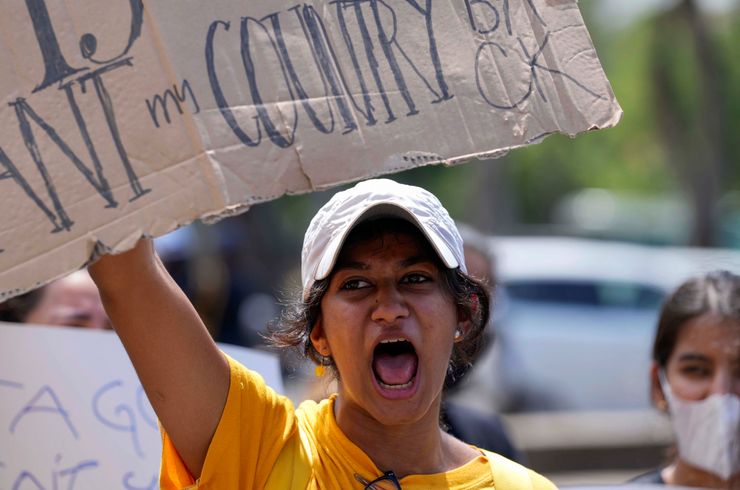
Sri Lankans including professionals, students and mothers with small children defied an emergency decree and curfew Sunday to demand the president’s resignation.
“In this country it is so difficult,” said Inoma Fazil, a fashion designer who brought her 18-month-old daughter to a protest in Colombo suburb Rajagiriya on Sunday. “We don’t want to leave the country and go, and we want to give our child a good future, but everyone is stealing our money. So we came here for her and the rest of the children.”
A couple joined the same rally straight from the hospital with their newborn. They were greeted with cheers by the protesters who sang Sri Lanka’s national anthem and waved flags and placards.
Near Sri Lanka's capital Colombo, students demonstrated and dispersed without incident, while armed soldiers and police stopped opposition lawmakers from marching to the iconic Independence Square. Police fired tear gas and water cannons at hundreds of university students who were trying to break through barricades near the town of Kandy in the tea-growing region.
For several months, Sri Lankans have endured long lines to buy fuel, cooking gas, foods and medicines, most of which comes from abroad and is paid for in hard currency. The fuel shortage has caused rolling power cuts lasting several hours a day.
The extent of the crisis became clear when Sri Lanka couldn’t pay for imports of basic supplies because of its huge debts and dwindling foreign reserves. The country’s usable foreign reserves are said to be less than $400 million, according to experts, and it has nearly $7 billion in foreign debt obligations for this year alone.
Rajapaksa last month said his government was in talks with the International Monetary Fund and turned to China and India for loans while he appealed to people to limit the use of fuel and electricity and “extend their support to the country.”
While public resentment is mostly on the Rajapaksa family, anger was also directed at politicians in general and a decades-long system that many feel has betrayed them. At the Colombo rally, protesters turned back an opposition lawmaker, calling out, “No politicians!”
“The main purpose of the curfew is to quell dissent against the government,” said Christopher Stephen, a construction businessman who held placards in the main road near his home.
“What the Rajapaksas have been doing all these years was to divide the people along ethnic and religious lines. But this has united all Sri Lankans — Sinhalese, Tamils, Muslims, Burghers — all want them out,” Stephen said, referring to the president and his powerful family.
Aman Ashraff, an advertising professional who was protesting in his neighborhood, said Sri Lanka has squandered the opportunity to optimize its potential after ending a decades-long civil war in 2009 because of misgovernance.
“This is the turn for the people to rise up and show that they are not going to tolerate the sort of corruption, the sort of greed and the sort of self-centered governance any further,” he said.
On Sunday, authorities blocked access for nearly 15 hours to Facebook, Twitter, YouTube, WhatsApp and other social media platforms that were used to organize protests.
The emergency declaration by Rajapaksa gives him wide powers to preserve public order, suppress mutiny, riot or civil disturbances or for the maintenance of essential supplies. Under the decree, the president can authorize detentions, seizure of property and search of premises. He can also change or suspend any law except the constitution.
More News

Netflix Hurries to Rewrite Its Narrative With Layoffs and a Sudden Firing
Despite strong revenues and profits, the streaming service cut 1,000 jobs and jettisoned its chief content officer. Drops in the stock price and viewer engagement are to blame.

M.L.B. Playoff Ads With Sydney Sweeney and Megan Fox Draw Backlash
Commercials with Sydney Sweeney promoting a gambling platform and Megan Fox endorsing male enhancement have rankled fans, and even athletes. Who is in charge?

Why Bad News in the Bond Market May Be Good News for Investors
In the contrarian logic of investing, rising interest rates have made bonds much more attractive, our columnist says.

U.S. Budget Deficit Nears $2 Trillion, a Reality Check for Trump’s Cost Cutting
Higher interest rates are inflating borrowing costs as the Trump administration spends on the Iran war and tariff refunds.

Indonesian Stocks Plunge as MSCI Threatens to Drop Market from Indexes
The potential downgrade by MSCI, an influential index provider, adds to a deepening crisis of investor confidence in the economic policies of President Prabowo Subianto.

Warsh Vows to Tame Inflation as A.I. Delivers ‘Shock’ to Economy
The Federal Reserve chairman stuck to his pledge to avoid providing guidance about the path forward for interest rates, but did nothing to convey an urgency to raise them later this month.

Watch: Did Tesla really just unveil a flying car?
Tesla CEO Elon Musk showcased the vehicle at a facility owned by his SpaceX company, which helped develop the model.

When Will the Fed Move on Rates?
Kevin Warsh, the central bank’s chairman, suggested he wouldn’t push to raise borrowing rates this month. But persistent inflation may force the Fed’s hand.

Banks expect to be hit with higher taxes in Budget
Senior banking executives have told the BBC they expect to be "on the menu" in the chancellor's Budget tax later this month.

Feel Like You’re Overpaying for Hotels? Blame Expedia, a New Lawsuit Says.
The booking giant is accused of breaking federal antitrust laws and forcing millions of customers to overspend on stays by as much as 30 percent.

Tesla Debuts 2026 Roadster ‘Flying’ Electric Sports Car
Elon Musk’s company and other automakers, like Jaguar and Bentley, are trying to sell very expensive electric cars to people who usually prefer gasoline-fueled luxury and performance.

Trump Hasn’t Lowered Drug Prices for These Voters
President Trump has been promoting his efforts to reduce drug prices, but many Americans have not seen relief from rising costs for prescriptions and insurance premiums.