
Sri Lanka's political chaos persists as crisis talks go on
Jul 12, 2022
A political vacuum continues in Sri Lanka with opposition leaders yet to agree on who should replace its roundly rejected leaders, whose residences are occupied by protesters angry over the country’s deep economic woes
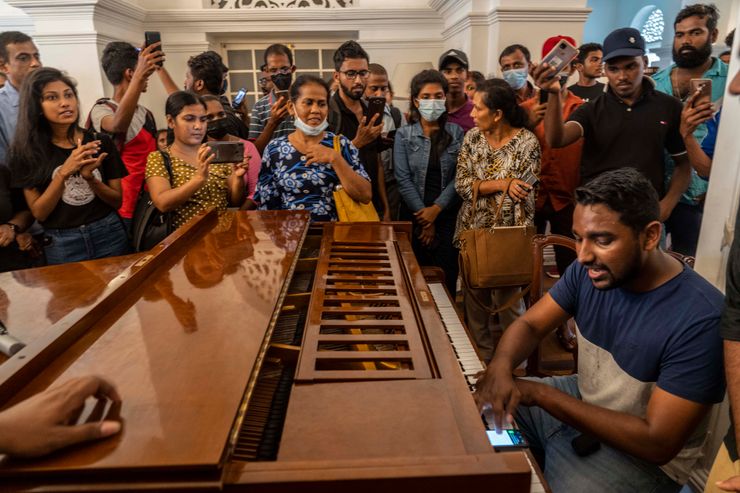
COLOMBO, Sri Lanka (AP) — A weekend of political chaos in Sri Lanka stretched into Monday, with opposition leaders yet to agree on replacements for embattled President Gotabaya Rajapaksa and his prime minister, whose residences remain occupied by protesters angered by the country’s economic collapse.
Crowds of demonstrators overran Rajapaksa’s home, his seaside office and the official residence of Prime Minister Ranil Wickremesinghe on Saturday and demanded they step down in the most dramatic day of the three-month crisis. Leaders of two opposition parties held talks Monday but could not agree on their choices for president and prime minister.
Corruption and mismanagement has left the island nation laden with debt, unable to pay for imports of food, fuel, medicine and other necessities, causing widespread shortages and despair among its 22 million people. The country is seeking help from neighboring India, China and the International Monetary Fund.
Rajapaksa has said he will step down on Wednesday, according to the speaker of parliament. The protesters have vowed to stay until the resignations are official.
In a video statement Monday, the first since the weekend protests, Wickremesinghe reiterated he will stay on until a new government is in place because he wants to work within the constitution.
“A government has to function according to the law. I am here to protect the constitution and through it fulfill the people’s demands,” Wickremesinghe said. “What we need today is an all-party government and we will take steps to establish that.”
The president hasn’t been seen or heard publicly since Saturday and his location is unknown. But his office said Sunday he ordered the immediate distribution of a cooking gas consignment to the public, indicating he was still at work.
Months of demonstrations have all but dismantled the Rajapaksa political dynasty, which has ruled Sri Lanka for most of the past two decades.
Wickremesinghe also explained the sequence of events that led to the burning of his private residence on Saturday. He said the protesters gathered around his house after a lawmaker, in what Wickremesinghe said was an inaccurate tweet, stated he had refused to resign at a meeting of parliamentary party leaders.
Police charged with batons and fired tear gas, he said, adding: "The last option was to shoot. We did not shoot but they came and burnt the house."
A group of nine Cabinet ministers said Monday they will quit immediately to make way for an all-party government, outgoing Justice Minister Wijayadasa Rajapakshe said. Wickremesinghe's office said another group that met with him decided to stay on until a new government is formed.
The talks by opposition party leaders to form an alternative unity government is an urgent requirement of a bankrupt nation to continue discussions with the IMF.
Lawmaker Udaya Gammanpila said the main opposition United People's Front and lawmakers who have defected Rajapaksa's ruling coalition have agreed to work together. Main opposition leader Sajith Premadasa and Dullas Alahapperuma, who was a minister under Rajapaksa, have been proposed to take over as president and prime minister and had been asked to decide on how to share the positions before a meeting with the parliamentary speaker Monday, but they did not reach an agreement.
“We can't be in an anarchical condition. We have to somehow reach a consensus today,” Gammanpila said.
Opposition parties also are concerned about military leaders making statements on public security in the absence of a civil administration.
Lawmakers discussed Chief of Defense Staff Gen. Shavendra Silva's statement over the weekend urging public cooperation to maintain law and order, said Kavinda Makalanda, spokesperson for Premadasa.
“A civil administration is the need, not the military, in a democratic country,” Makalanda said.
If opposition parties fail to form a government by the time Rajapaksa resigns, Wickremesinghe as prime minister will become acting president under the constitution. In line with the protesters' demands, however, opposition parties don't want him even as acting president.
They said that Wickremesinghe should promptly resign and allow Speaker Mahinda Yapa Abeywardena to be acting president — the next in line under the constitution. The Bar Association of Sri Lanka, the country's main lawyers' body, has also endorsed that position.
Rajapaksa appointed Wickremesinghe as prime minister in May to try to resolve the shortages and start economic recovery. But delays in restoring even basic supplies has turned public anger against him, with protesters accusing him of protecting the president.
When Wickremesinghe took over as prime minister to salvage the economy, he said it would take at least a year to complete the initial steps needed for a full recovery.
Wickremesinghe had been part of crucial talks with the IMF for a bailout program and with the World Food Program to prepare for a predicted food crisis. The government must submit a plan on debt sustainability to the IMF in August before reaching an agreement.
Sri Lanka is relying on aid from India and other nations until it is able to secure a deal in its negotiations with the IMF. Wickremesinghe said recently the talks were complex because Sri Lanka is now bankrupt.
Sri Lanka announced in April it was suspending repayment of foreign loans due to a foreign currency shortage. Its total foreign debt amounts to $51 billion, of which it must repay $28 billion by the end of 2027.
In describing the burning of his residence Saturday, Wickremesinghe said he lost what he called “my biggest treasure” — his library of 2,500 books, including those written during the Portuguese and Dutch colonial period from the 16th and 19th centuries. He said there were old books written on Buddhism, those signed by leaders like former U.S. Secretary of State Henry Kissinger, historical paintings and Buddhist artifacts, which he had planned donating to his old school and a university after his death.
He said he also lost all of his collection of paintings except for one.
More News

Why Bad News in the Bond Market May Be Good News for Investors
In the contrarian logic of investing, rising interest rates have made bonds much more attractive, our columnist says.

U.S. Budget Deficit Nears $2 Trillion, a Reality Check for Trump’s Cost Cutting
Higher interest rates are inflating borrowing costs as the Trump administration spends on the Iran war and tariff refunds.

Indonesian Stocks Plunge as MSCI Threatens to Drop Market from Indexes
The potential downgrade by MSCI, an influential index provider, adds to a deepening crisis of investor confidence in the economic policies of President Prabowo Subianto.

Warsh Vows to Tame Inflation as A.I. Delivers ‘Shock’ to Economy
The Federal Reserve chairman stuck to his pledge to avoid providing guidance about the path forward for interest rates, but did nothing to convey an urgency to raise them later this month.

Watch: Did Tesla really just unveil a flying car?
Tesla CEO Elon Musk showcased the vehicle at a facility owned by his SpaceX company, which helped develop the model.

When Will the Fed Move on Rates?
Kevin Warsh, the central bank’s chairman, suggested he wouldn’t push to raise borrowing rates this month. But persistent inflation may force the Fed’s hand.

Banks expect to be hit with higher taxes in Budget
Senior banking executives have told the BBC they expect to be "on the menu" in the chancellor's Budget tax later this month.

Feel Like You’re Overpaying for Hotels? Blame Expedia, a New Lawsuit Says.
The booking giant is accused of breaking federal antitrust laws and forcing millions of customers to overspend on stays by as much as 30 percent.

Tesla Debuts 2026 Roadster ‘Flying’ Electric Sports Car
Elon Musk’s company and other automakers, like Jaguar and Bentley, are trying to sell very expensive electric cars to people who usually prefer gasoline-fueled luxury and performance.

Trump Hasn’t Lowered Drug Prices for These Voters
President Trump has been promoting his efforts to reduce drug prices, but many Americans have not seen relief from rising costs for prescriptions and insurance premiums.

Fuel costs squeezing margins for some businesses
Diesel recently topped £2 per litre and there is concern that a duty freeze will not go far enough.

'TV and cheap booze' blamed for landlord quitting
Lincolnshire has lost 27% of its pubs and bars since 2009 and some are calling on the government to act against cheap supermarket booze.