
Wall Street opens higher a day after biggest drop since May
Sep 21, 2021
Stocks are opening modestly higher on Wall Street, making up some of the ground they lost in a sharp pullback a day earlier
Stocks are opening modestly higher on Wall Street, making up some of the ground they lost in a sharp pullback a day earlier. The S&P 500 was up 0.4% in the early going Tuesday, and the Dow Jones Industrial Average and the Nasdaq were also up similar amounts. Technology companies were doing particularly well, a day after leading the market lower. Uber jumped 7.6% after raising its outlook. European markets were also higher, and Asian markets mostly rose. Chinese markets remained closed for a holiday. Energy prices were mostly higher. The yield on the 10-year Treasury note held steady at 1.31%.
THIS IS A BREAKING NEWS UPDATE. AP’s earlier story follows below.
TOKYO (AP) — Global shares were mixed on Monday, with European benchmarks and U.S. futures higher after a choppy day of trading in Asia.
France's CAC 40 added 1.4% in early trading to 6,546.97, while Germany's DAX rose 1.5% to 15,357.83. Britain's FTSE 100 edged up 1.0% to 6,975.51. U.S. shares were set for gains, with the future for the Dow industrials gaining 1.1% to 34,211.00. The S&P 500 future climbed 1.0% to 4,392.75.
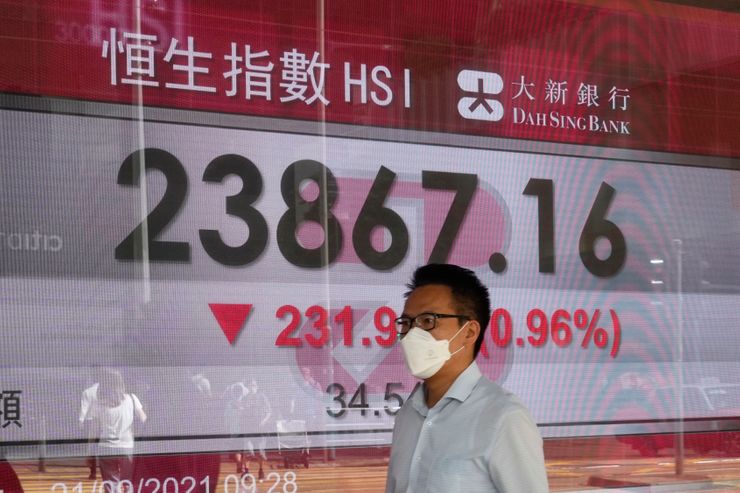
In Hong Kong, the Hang Seng recouped earlier losses, gaining 0.5% to 24,221.54. Tokyo's Nikkei 225 dropped 2.2% to finish at 29,839.71. Australia’s S&P ASX 200 gained 0.4% to 7,273.80.
Worries over heavily indebted Chinese real estate developer Evergrande are weighing on sentiment.
Analysts said fears the damage from a property bust in China could ripple worldwide were drawing on memories of past financial crises such as the bursting of the Japanese “bubble” economy or the 2008 sub-prime mortgage crisis.
In Japan, that catastrophe is called the Lehman crisis for the 2008 collapse of the Lehman Brothers which aggravated the situation.
“The whisper is that this could be China’s ‘Lehman moment.’ Even with Chinese markets closed until Wednesday, we are seeing knock-on sell-offs around the world,” said RaboResearch.
Property companies have been big drivers of the Chinese economy, which is the world’s second-largest.
If they fail to make good on their debts, losses taken by investors who hold their bonds would raise worries about their financial strength. Those bondholders could also be forced to sell other, unrelated investments to raise cash, which could hurt prices in seemingly unrelated markets.
It’s a product of how tightly connected global markets have become, and it’s a concept the financial world calls “contagion.”
Many analysts say they expect China’s government to prevent such a scenario, and that this does not look like a Lehman-type moment. Nevertheless, any hint of uncertainty may be enough to upset Wall Street after the S&P 500 has glided higher in almost uninterrupted fashion since October, leaving stocks looking expensive and with less room for error.
On top of those worries, investors are watching to see if the Federal Reserve might ease off the accelerator on its support for the economy. And heavy government spending to counter the impact of the pandemic has raised the likelihood that Congress may opt for a destructive game of chicken before allowing the U.S. Treasury to borrow more money.
The Fed is due to deliver its latest economic and interest rate policy update on Wednesday.
In energy trading, benchmark U.S. crude rose $1.04 to $71.33 a barrel. Brent crude, the international standard, added $1.21 to $75.13 a barrel.
In currency trading, the U.S. dollar rose to 109.62 Japanese yen from 109.39 yen. The euro cost $1.1734, up from $1.1726.
More News

M.L.B. Playoff Ads With Sydney Sweeney and Megan Fox Draw Backlash
Commercials with Sydney Sweeney promoting a gambling platform and Megan Fox endorsing male enhancement have rankled fans, and even athletes. Who is in charge?

Netflix Hurries to Rewrite Its Narrative With Layoffs and a Sudden Firing
Despite strong revenues and profits, the streaming service cut 1,000 jobs and jettisoned its chief content officer. Drops in the stock price and viewer engagement are to blame.

Why Bad News in the Bond Market May Be Good News for Investors
In the contrarian logic of investing, rising interest rates have made bonds much more attractive, our columnist says.

U.S. Budget Deficit Nears $2 Trillion, a Reality Check for Trump’s Cost Cutting
Higher interest rates are inflating borrowing costs as the Trump administration spends on the Iran war and tariff refunds.

Indonesian Stocks Plunge as MSCI Threatens to Drop Market from Indexes
The potential downgrade by MSCI, an influential index provider, adds to a deepening crisis of investor confidence in the economic policies of President Prabowo Subianto.

Warsh Vows to Tame Inflation as A.I. Delivers ‘Shock’ to Economy
The Federal Reserve chairman stuck to his pledge to avoid providing guidance about the path forward for interest rates, but did nothing to convey an urgency to raise them later this month.

A new railway corridor: How Nanning links Chinese and ASEAN markets
A new railway corridor: How Nanning links Chinese and ASEAN markets

Watch: Did Tesla really just unveil a flying car?
Tesla CEO Elon Musk showcased the vehicle at a facility owned by his SpaceX company, which helped develop the model.

China and Europe are building new connections in aerospace
China and Europe are building new connections in aerospace – from skies to stars. On the one hand, their deep industrial partnership is scaling global civil aviation to new heights. On the other hand, scientific collaboration is opening new possibilities for space exploration and deepening our understanding of the Sun-Earth system.

BizTalk | Exclusive interview with Former PM of Bosnia and Herzegovina
In this episode of BizTalk, CGTN's Guan Xin speaks with Zlatko Lagumdzija, former prime minister of Bosnia and Herzegovina, about China's development and its role in global governance.

When Will the Fed Move on Rates?
Kevin Warsh, the central bank’s chairman, suggested he wouldn’t push to raise borrowing rates this month. But persistent inflation may force the Fed’s hand.

Banks expect to be hit with higher taxes in Budget
Senior banking executives have told the BBC they expect to be "on the menu" in the chancellor's Budget tax later this month.